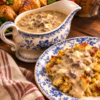
The Dressing That Defines Us: A Thanksgiving Tradition Across America
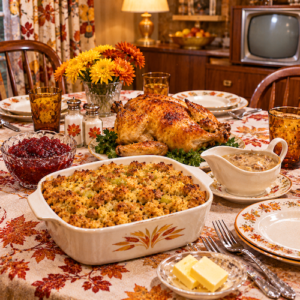
Growing up in our house, Thanksgiving dinner rarely featured turkey, as my father wasn't particularly fond of it. Momma usually roasted a large chicken instead. But there was one thing that never changed—a large dish of her delicious cornbread dressing, accompanied by a generous helping of giblet gravy.
Momma made her Thanksgiving dressing with day-old crumbled cornbread, some herbs and seasonings, a little milk-soaked 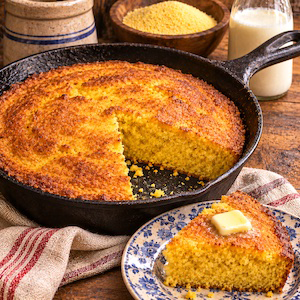 lightbread, and eggs to bind everything together. And it never went inside the bird. Momma always baked her dressing separately in a large casserole dish, allowing it to develop a golden crust while the interior remained moist and tender.
The cornbread itself was a family tradition. My grandmother, whom we called Grandma Etchieson, taught Momma how to make it, and Momma passed the recipe along to me when I was eleven years old. It was old-fashioned Southern cornbread, made with stoneground cornmeal, buttermilk, an egg, and bacon drippings. No flour, no sugar, and certainly none of those sweet cornbread mixes that have become so popular today.
The recipe was simple enough, but there was a certain technique involved, particularly when it came to heating the bacon drippings in a cast-iron skillet and sprinkling a little cornmeal into the hot fat before adding the batter. That gave the bread a wonderfully crisp bottom crust and a flavor I've never found in cornbread baked any other way.
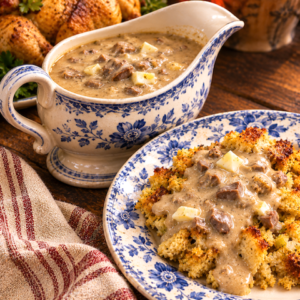 Momma's giblet gravy was another Thanksgiving essential. She made it from the chicken's giblets—gizzard, heart, liver—along with the neck, thickening the cooking liquid with a roux and adding little milk and chopped hard-boiled egg. Ladled over a generous helping of dressing, it was Thanksgiving on a plate.
It wasn't until I grew older and began cooking professionally that I fully appreciated just how many different versions of this humble dish existed across America. What we called dressing, others called stuffing. Some made it with white bread, others with cornbread, rice, oysters, sausage, or chestnuts. And just about everybody seemed convinced that their family's version was the proper way to make it.
As it turns out, the history of Thanksgiving dressing is a good deal older, and considerably more interesting, than the holiday itself.
Long Before the First Thanksgiving
Exactly when cooks began stuffing poultry and other meats with seasoned mixtures remains one of those many culinary mysteries. We do know that the practice dates back at least to ancient Rome. The culinary collection commonly known as Apicius, or De Re Coquinaria, contains recipes for preparing stuffed animals using combinations of herbs, grains, nuts, eggs, and assorted meats.
By the Middle Ages, European cooks had developed an assortment of stuffings for poultry, game, and roasted meats. While some contained chopped meat, organ meats, nuts, dried fruits, and spices, others incorporated breadcrumbs or pieces of stale bread, which were economical, readily available, and particularly good at absorbing flavorful cooking juices. Over time, bread became an increasingly common foundation for stuffing, helping stretch more expensive ingredients while transforming what began as a practical cooking method into a dish worthy of attention in its own right.
When European settlers arrived in North America, they brought these cooking traditions with them. But the ingredients available in their new surroundings weren't always the same as those they had known in Europe.
Corn, or maize, had been cultivated and prepared in numerous ways by Indigenous peoples of the Americas for thousands of years. As European settlers adopted cornmeal into their own breads, porridges, and other dishes, it gradually became an important part of colonial cooking.
Over time, the combination of European bread-based stuffing traditions and American cornmeal cookery helped give rise to the cornbread dressings that would become familiar throughout the South. But that development took generations, and it would be a mistake to assume that the foods we associate with Thanksgiving today were served at the earliest colonial harvest celebrations.
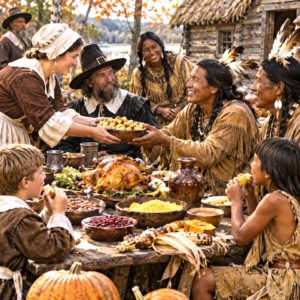 Take the often-romanticized 1621 harvest gathering shared by English colonists at Plymouth and members of the Wampanoag people. The surviving accounts tell us very little about the preparation of individual dishes. Wildfowl and venison were part of the feast, but whether any birds were stuffed, and with what, remains uncertain.
The Thanksgiving dinner we recognize today developed over generations, influenced by regional ingredients, changing tastes, and the gradual establishment of the holiday itself.
How Dressing Became a Thanksgiving Tradition
For much of early American history, Thanksgiving wasn't the uniform national celebration we know today. Different colonies and states observed days of thanksgiving at different times, and the foods served varied according to local customs and what was available.
That began to change during the nineteenth century, thanks in considerable part to Sarah Josepha Hale, the influential editor of Godey's Lady's Book. Hale spent decades advocating for a national Thanksgiving holiday, promoting the occasion through articles, stories, and recipes.
Her vision of Thanksgiving centered on a generous family meal, often featuring roast turkey and the familiar accompaniments that 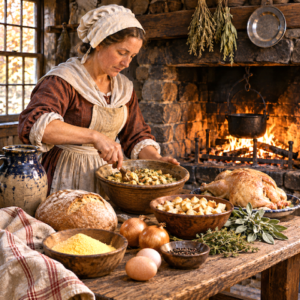 gradually became associated with the holiday. President Abraham Lincoln proclaimed a national Thanksgiving observance in 1863, helping establish the celebration as an American tradition.
As Thanksgiving became more widely observed, stuffing and dressing found a regular place beside the holiday bird. But the dish was never entirely standardized. Families continued to prepare it according to their regional foodways, available ingredients, and inherited recipes.
Even the question of what to call it became a matter of regional preference.
In many parts of the North, stuffing was the customary name, particularly when the mixture was cooked inside a bird. Across much of the South, dressing became the preferred term, whether it was baked separately or used to fill poultry. The words have often been used interchangeably, and their history is more complicated than the familiar explanation that one goes inside the bird while the other doesn't.
Frankly, I don't much care what somebody calls it. If it's properly seasoned, moist, and flavorful, I'm happy to eat it.
One Holiday, a Hundred Different Dressings
Perhaps the most fascinating thing about Thanksgiving dressing is how clearly it reflects America's regional cooking traditions.
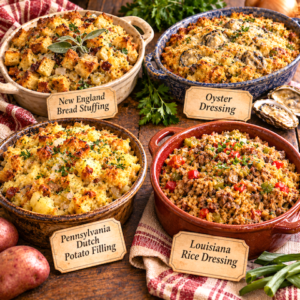
In New England, wheat bread became the foundation for many traditional stuffings. Cubes of stale bread were combined with onions, celery, butter, sage, thyme, and other seasonings, then moistened with broth. Some families added sausage, apples, or chestnuts, ingredients that reflected the agricultural products and culinary traditions of the region.
 Chestnut stuffing was particularly appealing in areas where American chestnut trees once flourished. Before chestnut blight devastated those forests during the twentieth century, the nuts were plentiful and widely used in cooking. Their mild sweetness and substantial texture made them a natural addition to holiday stuffings.
Along the Atlantic coast, oysters became another popular ingredient. In the days before modern refrigeration and transportation, oysters were especially abundant and accessible in many coastal communities. They appeared in soups, stews, pies, and stuffings, sometimes combined with bread or crackers, butter, onions, and herbs.
Oyster dressing eventually spread well beyond the coast, becoming a cherished holiday tradition in parts of the Mid-Atlantic, New England, and the South. To some families, Thanksgiving simply wouldn't be Thanksgiving without it.
In Pennsylvania Dutch country, potato filling developed into a distinctive holiday favorite. Combining mashed potatoes with bread, onions, butter, and seasonings, it brought together two familiar staples in a rich, comforting dish. Depending on the household, it might be baked in a casserole or served with roasted poultry.
Across the South, cornbread became the defining ingredient. Unlike many Northern bread stuffings, Southern cornbread dressing generally relied on crumbled cornbread moistened with broth, enriched with eggs, and seasoned with onions, celery, sage, and poultry seasoning.
The resulting texture could vary considerably. Some cooks preferred a fairly firm dressing, while others, including my momma, wanted it soft enough to spoon onto the plate, with a crisp top and browned edges.
Southern cooks also developed countless variations. Some added sausage or chopped chicken, others included oysters, boiled eggs, or pecans. In certain households, a little white bread or leftover biscuits helped bind the cornbread together.
In Louisiana, the story takes another turn. Rice dressing, closely related to the Creole and Cajun dish known as dirty rice, became a popular accompaniment to holiday meals. Made with rice, onions, celery, bell peppers, seasonings, and often ground meat or finely chopped giblets, it reflects the region's distinctive blend of culinary influences.
These are only a handful of the variations found across the country. In different communities, holiday dressings may include wild rice, mushrooms, apples, dried fruits, nuts, or even seafood.
And each has its own history, shaped by the people who prepared it and the ingredients available to them.
From Yesterday's Bread to a Holiday Tradition
There's something wonderfully ironic about the place dressing occupies on today's Thanksgiving table.
For centuries, bread-based stuffings offered a practical way to use stale bread, stretch ingredients, and make a modest quantity of meat feed more people. A few pieces of yesterday's bread, some onions, herbs, and cooking liquid could become a substantial accompaniment to the family meal.
In many households, nothing edible was casually thrown away. Leftover biscuits, cornbread, and lightbread could be saved and transformed into something entirely different.
Today, we often go out of our way to prepare those same ingredients specifically for Thanksgiving. We bake cornbread a day or two in advance, purchase special breads, toast nuts, prepare stocks, and spend considerable time assembling a dish that began, at least in part, as an exercise in household economy.
What was once a way of making good use of leftovers has become one of the most anticipated dishes of the holiday—and in some families, considerably more important than the turkey itself.
I suspect that would have suited my daddy just fine.
Nobody Makes It Quite Like Momma Did
Ask a dozen people how their mothers or grandmothers made Thanksgiving dressing, and you're likely to get a dozen different answers.
Some insist that sage is absolutely essential. Others prefer poultry seasoning or a combination of herbs. Some use only cornbread, while others add white bread, biscuits, or crackers. Some want their dressing firm enough to slice, while others wouldn't dream of serving anything that didn't require a spoon. Perhaps that's what makes dressing such an enduring Thanksgiving tradition.
Unlike a roast turkey, which is prepared in much the same way in kitchens across America, dressing allows for almost endless variation. It reflects regional ingredients, family preferences, and the accumulated experience of generations of home cooks.
And frequently, the recipes were never written down.
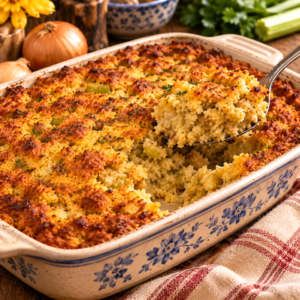 Grandma knew how much sage to add because she'd been making dressing for years. Momma knew how much broth was needed because she could tell by looking at the mixture. A handful of this, a spoonful of that, and enough liquid to make it look right.
Those weren't necessarily imprecise methods. They were methods developed through experience, something I know a little about myself.
When Momma taught me to make cornbread at the age of eleven, she didn't reach for a set of measuring spoons every time she added an ingredient. Neither had her mother. An ordinary kitchen spoon usually did the job, and that's still how I often cook today.
Over the years, I've tried to put standardized measurements to those old family recipes so that my children, grandchildren, and others can reproduce them. But some things are difficult to express in tablespoons and measuring cups.
The amount of broth needed for a pan of cornbread dressing is one of them. It depends on the cornbread, how dry it is, how finely it's crumbled, and how much liquid it absorbs.
Momma knew when hers was right. After making it for so many years, I generally do, too.
I've also made a few additions of my own. I almost always brown some pork breakfast sausage, breaking it into small pieces as it cooks, then sauté the onions and celery in the same skillet with a little butter. Occasionally, I'll add toasted pecan pieces for a bit of texture.
Those ingredients weren't part of Momma's original recipe, but I think she'd approve.
And that, too, is part of the story. Family recipes don't necessarily remain unchanged from one generation to the next. They evolve as each cook adds a personal touch, while preserving the flavors and techniques that made them special in the first place.
The Dressing That Defines Us
On Thanksgiving Day in 1994, Momma and I prepared her cornbread dressing together for the last time. It was the same dressing she'd made for as long as I could remember, using the cornbread recipe her mother had taught her many years before.
Momma died on March 16, 1995, just a few months after that Thanksgiving.
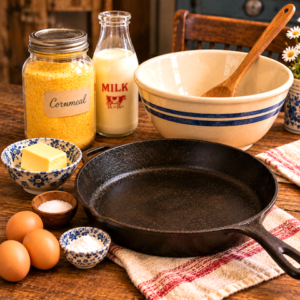 I still have the old cast-iron skillet she used to bake her cornbread, and I still use it regularly. The skillet has seen a great many batches of cornbread over the years, and I imagine it will see a few more before I'm through.
I've spent much of my life working in professional kitchens, preparing everything from simple country meals to elaborate dishes for special occasions. But some of the foods that mean the most to me are the ones I learned to make as a boy, standing beside my mother in her kitchen.
And that brings me back to Thanksgiving dressing.
Whether it's made with cornbread, lightbread, oysters, chestnuts, potatoes, or rice, the dish tells us something about the people who prepared it and the places they called home. Its ingredients reflect America's regional food traditions, while its preparation often preserves the habits and techniques of generations past.
What began as a practical way to make use of ordinary ingredients has become something far more meaningful—a family tradition that survives long after the people who first taught us to prepare it are gone.
So this Thanksgiving, whether you're spooning cornbread dressing onto your plate or helping yourself to a generous serving of oyster stuffing, take a moment to remember where that recipe came from.
Chances are, there's a story behind it.
And if you're fortunate enough to have learned that recipe from your mother or grandmother, you may be carrying on a tradition that's worth considerably more than the ingredients that go into it.
For me, that tradition will always begins with a hot cast-iron skillet, a pan of Grandma Etchieson's cornbread, and the memory of Momma's Thanksgiving dressing.