Makheua Yao Pad Tao Jiao
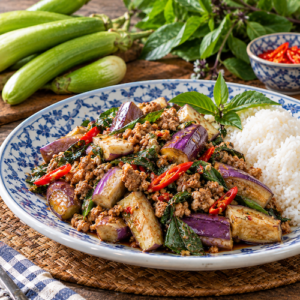
Thai Stir-Fried Eggplant with Ground Pork and Fermented Soybean Paste
A popular Thai-Chinese dish often served at Thailand's curry-and-rice stalls, makheua yao pad tao jiao combines tender eggplant with ground pork, garlic, fresh chiles, and fermented yellow soybean paste. The soybean paste gives the dish its distinctive savory flavor, while fresh Thai basil adds a fragrant, slightly anise-like finish. Unlike many Western eggplant preparations, this dish comes together quickly in a hot wok, allowing the eggplant to absorb the richly seasoned sauce without losing its shape. Served over steamed jasmine rice, it makes a satisfying meal and offers a delicious introduction to eggplant as it is prepared in Thai kitchens.
Whatcha Need
For the eggplant
- 4 Japanese or Chinese long eggplants (about 1½ pounds/680 grams)
- Vegetable oil for frying
For the stir-fry:
- 14 ounces (400 grams) ground pork
- 6 garlic cloves, roughly chopped
- 2-3 fresh Thai bird’s eye chiles, thinly sliced, or to taste
- 1 cup loosely packed fresh Thai sweet basil leaves
- 1 tablespoon vegetable oil, as needed
For the sauce:
- 2 tablespoons (about 35-40 grams) Thai fermented yellow soybean paste (tao jia)
- 1 tablespoon (about 15 ml) light soy sauce
- 1 tablespoon (about 15 ml) oyster sauce
- 1 teaspoon granulated sugar
- ¼ cup (60 ml) water
- Steamed Thai jasmine rice, for serving
Whatcha Do
- Prepare the eggplant: Trim the stems and cut the eggplants crosswise into approximately 2-inch lengths. Halve or quarter each piece lengthwise, depending on its thickness, to make fairly uniform, bite-sized pieces.
- Prepare the Sauce: In a small bowl, combine the fermented soybean paste, light soy sauce, oyster sauce, sugar, and water. Stir until well blended and set aside.
- Cook the Eggplant: Heat about ½ inch of vegetable oil in a wok or deep skillet over medium-high heat to approximately 350℉. Working in batches, fry the eggplant for 1–2 minutes, turning occasionally, until just tender and lightly colored. Remove with a slotted spoon and drain on paper towels. The eggplant should be tender but still hold its shape.
- Cook the pork: Carefully pour off the frying oil, reserving about 1 tablespoon in the wok. Return the wok to medium-high heat. Add the ground pork and stir-fry, breaking it into small pieces, until lightly browned and cooked through, about 4–5 minutes.
- Add the aromatics: Add the garlic and sliced chiles to the pork. Continue stir-frying for about 30 seconds, just until fragrant, taking care not to burn the garlic.
- Add the sauce: Pour the prepared sauce into the wok and bring to a gentle simmer, stirring to coat the pork evenly.
- Finish the dish: Return the eggplant to the wok and gently toss with the pork and sauce. Cook for another 1–2 minutes, or until the eggplant is fully tender and has absorbed some of the sauce. If the mixture becomes too dry, add another tablespoon or two of water.
- Add the basil and serve: Remove the wok from the heat, add the Thai basil leaves, and toss gently until just wilted. Serve immediately with hot steamed jasmine rice.
Notes:
- Thai fermented yellow soybean paste, often labeled tao jiao or tao jiew, is available in many Asian markets. It is not interchangeable in equal amounts with ordinary yellow miso without changing the flavor.
- Ground chicken may replace the pork. For a vegetarian version, use crumbled firm tofu and substitute mushroom-based vegetarian stir-fry sauce for the oyster sauce.
- Thai bird's eye chiles can be extremely hot. Adjust the quantity according to your preference.
- For a lighter preparation, the eggplant may be pan-cooked with a little oil and water, covered briefly until tender, rather than fried. The finished texture and flavor will be somewhat different.