Beyond the Purple Globe: The Remarkable World of Eggplant.
Growing up as the son of hardworking Oklahoma farm parents, our meals consisted of very common country- style fare—beans, greens, potatoes, cornbread, and occasionally some kind of meat, mostly chicken. Red meat was rare, and fish, except for canned tuna and salmon, even more so.
And though I worked most of my high school years in a big-box supermarket with a huge produce department, I never experienced much of what we sold. I certainly knew what eggplant was, having sold plenty of those beautiful, shiny purple globes. But it wasn’t until I met the daughter of an Italian restaurant family that I was introduced to its flavor—and, quite frankly, wasn’t all that excited about it at first.
Perhaps my initial reaction to eggplant was more about the mouthfeel than its taste, which I’ve always found rather mild. It was the spongy, mushy texture I objected to most, something I 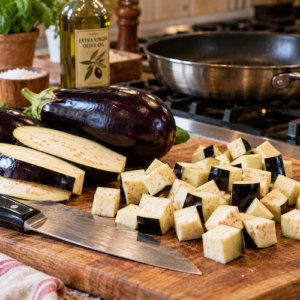 suspect had more to do with the way it was prepared than with the eggplant itself.
Now, after many years of eating and preparing eggplant in a variety of ways, I’ve grown quite fond of it’s distinctive flavor and remarkable versatility.
Where eggplant was first domesticated remains something of a botanical mystery. Its story appears to begin not at a single point on the map, but across a broad swath of South and Southeast Asia. Modern genetic evidence points particularly toward the Indian subcontinent and Southeast Asia as important centers of domestication, with China also playing an important role in its early cultivation and development.
From Asia, eggplant gradually traveled westward through Persia and the Arab world, becoming well established in Middle Eastern and Mediterranean cooking. By the Middle Ages it was known in parts of Europe, including Italy, where it would eventually become an important part of the cuisine.
Eggplant was known in colonial America as well. Thomas Jefferson, our third president and an avid gardener, reported growing both white and purple eggplants at Monticello in the early 1812. Yet for many Americans, the plant remained unfamiliar. Some varieties were grown primarily as ornamentals, and historical suspicions surrounding members of the nightshade family did little to encourage their acceptance as food. Over time, immigration—particularly from cultures with long traditions of cooking eggplant—helped broaden its place on the American table.
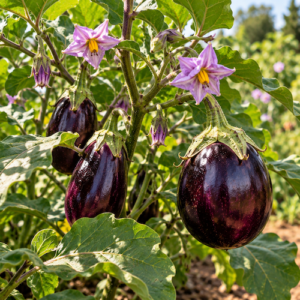
The large, glossy purple eggplant I remember from my supermarket days is only one member of an extraordinarily diverse family.
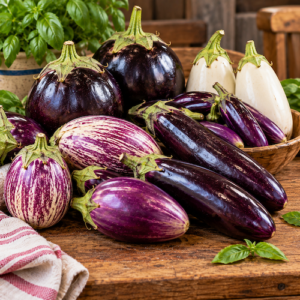 There are hundreds of cultivated eggplant varieties, differing in size, shape, color, texture, and flavor. And although we cook eggplant as a vegetable, botanically it is a fruit—specifically, a berry. While these varieties can be grouped loosely by their appearance, the differences go well beyond the familiar purple globes found in most American supermarkets. Some are long and slender, others small and round, and still others resemble little eggs. Their colors range from deep purple and lavender to green, white, yellow, and even orange.
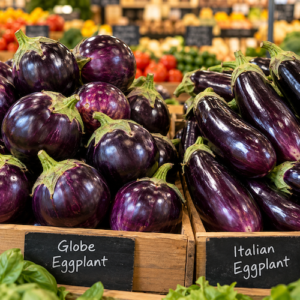
Globe eggplants, often called American eggplants, are probably the most familiar. They are the large, hefty, pear-shaped fruits I remember selling, with their shiny, deep-purple skins and spongy, meaty flesh. Italian eggplants are generally somewhat smaller, with a similar shape and often a more tender texture and milder flavor. Both types are remarkably versatile, lending themselves to baking, roasting, grilling, frying, and stuffing.
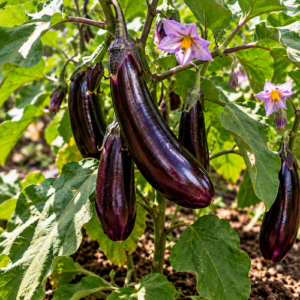 Then there are the long, slender eggplants commonly associated with Asian cooking. Many have thinner skins and tender flesh, making them especially suitable for stir- frying, grilling, and roasting. Japanese varieties such as Ichiban, Millionaire, and Shikou produce elongated, dark- purple fruits, while Chinese Long types often display beautiful shades of lavender or light purple. Italy has its own Long Purple varieties, generally somewhat broader than their Asian counterparts.
Some of the most unusual eggplants are those that actually resemble the eggs from which the vegetable takes its English name. The Thai Yellow Egg, for example, produces small, egg-shaped fruits that turn bright yellow as they mature. Another 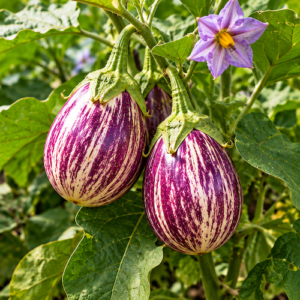 striking variety is Listada de Gandia, a Spanish heirloom with oval fruits beautifully streaked in purple and white. There are even orange and reddish eggplant relatives whose appearance seems almost too unusual to belong to the same general family.
Beyond these familiar shapes lies a fascinating assortment of specialty eggplants, many developed for particular growing conditions or culinary traditions.
Patio Baby, for instance, is a compact variety especially well suited to container gardening. It produces small, glossy, dark-purple fruits, generally about three inches long, with tender flesh that makes them excellent for roasting whole or threading onto skewers.
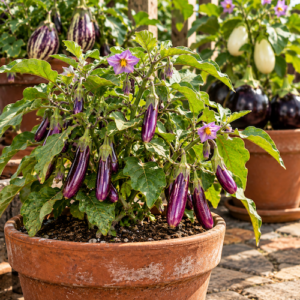 Little Fingers is another productive miniature variety, bearing clusters of slender, dark-purple digits that can be sautéed whole. Like Patio Baby, it offers home gardeners an opportunity to grow eggplants without needing a large garden.
Among the Italian specialties is Barbarella, a round, somewhat flattened eggplant with deep-purple skin and a pale area near its stem. Its shape is reminiscent of a large heirloom tomato, and
its tender flesh makes it suitable for roasting, grilling, or stuffing.
Asian varieties offer still more diversity. Taiwan's Ping Tung Long produces remarkably elongated, slender purple fruits, while Thai Long Green bears narrow, pale-green eggplants. Both are valued for their tender flesh and usefulness in stir-fries and other quickly cooked dishes.
India, where eggplant has been cultivated for centuries and is widely known as brinjal, offers an enormous assortment of varieties. Some produce small, round, reddish-purple fruits barely two inches across, particularly well suited to stuffing or cooking whole in curries.
And then there are the so-called pea eggplants, which introduce another interesting branch of the nightshade family. Unlike the varieties described above, some of these belong to different botanical species rather than being cultivars of the common eggplant.
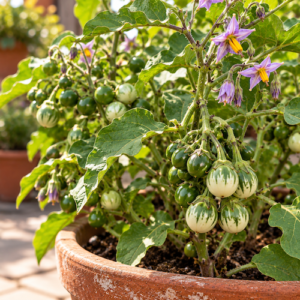 One of the best-known is turkey berry (Solanum torvum), a thorny shrub producing clusters of small, round, green fruits resembling peas. Although native to tropical America, it has found a place in several tropical cuisines. Its distinctly bitter flavor is appreciated in Thai cooking, where it appears in curries, and in Caribbean cooking, where it is sometimes known as susumber.
Other small-fruited eggplant relatives are cultivated and eaten in parts of Africa and Asia, demonstrating just how far the culinary use of these plants extends beyond the familiar purple globe.
Taken together, these varieties reveal an extraordinary range of colors, shapes, flavors, and textures. And while their appearances may differ dramatically, it is what cooks around the world have learned to do with them that makes eggplant such a remarkable food.
The first time I truly enjoyed eggplant was the evening my Italian fiancé prepared the iconic Italian-American eggplant parmesan for dinner. Layers of sliced and fried eggplant, Parmesan and mozzarella cheeses, and a delicate filetto di pomodoro sauce, all baked together into something resembling a meatless lasagna. Even today, this is probably my favorite eggplant dish.
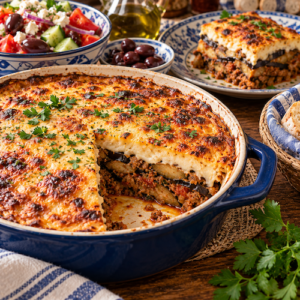 The Greeks have their own wonderful layered eggplant dish called moussaka. Although quite different from eggplant Parmesan, it combines layers of fried or baked eggplant with a rich, tomato-based meat sauce, all topped with creamy béchamel and baked golden brown. Some versions also include a layer of thinly sliced, baked or fried potatoes. However you prepare it, the combination is hard to resist.
Eggplant rollatini, or involtini, is another Italian-American favorite I’m especially fond of. Thin slices of globe eggplant are baked or fried, then rolled around a filling of ricotta, fresh herbs, and grated cheeses. The little rolls are nestled into a baking dish with marinara sauce and baked until hot and bubbly.
A popular dish throughout the Middle East is baba ganoush, a creamy, smoky dip made from roasted or charred eggplant, tahini, 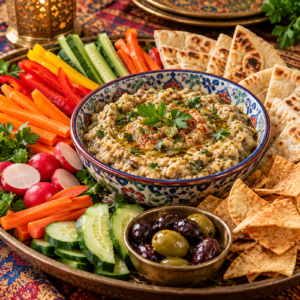 garlic, lemon juice, and olive oil. Often served with warm pita bread, it is a wonderful example of how a vegetable with such a mild flavor can be transformed by something as simple as roasting it over an open flame.
A favorite Thai-Chinese eggplant dish, often found at Thai curry-and-rice stalls known as khao gaeng, is makheua yao pad tao jiao. This flavorful stir-fry combines long eggplant with minced pork, fermented yellow soybean paste (tao jiao), garlic, fresh chiles, and Thai basil. It's a fine example of how eggplant readily absorbs the flavors of the ingredients surrounding it.
And I would be remiss not to mention beautiful Provençal preparation closely related to the French classic ratatouille. Often called a vegetable tian, this dish features thin slices of eggplant, zucchini, summer squash, and sometimes tomatoes, arranged in overlapping rows or concentric circles over a bed of seasoned tomato sauce. Slowly baked until the vegetables are tender, it is as pleasing to the eye as it is to the palate.
When I think back to those days working in the supermarket produce department, surrounded by fruits and vegetables I knew little about, I can't help but smile. Those beautiful, shiny purple eggplants were just another item to stock and sell. I had no idea of their long history, the extraordinary variety of shapes and colors they came in, or the countless ways cooks around the world had learned to prepare them.
 And perhaps that's one of the wonderful things about food. No matter how many years we've spent in the kitchen, there's always something new to discover—or something familiar waiting to be appreciated in a different way. For me, eggplant is a perfect example. What began as a vegetable I wasn't particularly fond of has become one I genuinely enjoy.