From Maple Woods to the Atlantic Shore: Indigenous Foods of the Northeast
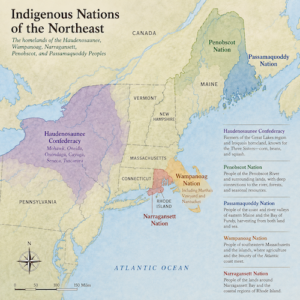
From the hardwood forests and maple groves of New York and New England to the rivers, bays, and rocky shores of the Atlantic, Indigenous peoples built food traditions around a landscape that offered remarkable abundance. The Haudenosaunee Confederacy cultivated fields of corn, beans, and squash and gathered maple sap, nuts, berries, and wild plants from the surrounding forests. Farther east and south, the Wampanoag and Narragansett combined agriculture with the bounty of coastal waters, while the Penobscot and Passamaquoddy drew sustenance from the forests, rivers, lakes, and cold waters of what is now Maine. Each Nation developed its own traditions, yet all shared an intimate knowledge of the seasons and of when the land and water would yield their particular harvests.
Corn—especially varieties of white flint corn—was central to much of the region, but it was only part of a far more varied table. Maple sap was boiled into sugar; cranberries and blueberries were eaten fresh, dried, and preserved; roots and tubers were dug from the earth; and forests provided nuts, game, and edible plants. Along the coast and waterways, clams, 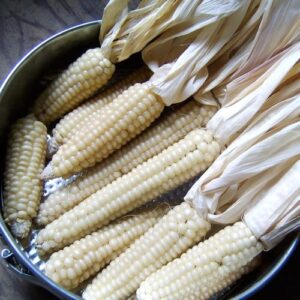 quahogs, oysters, mussels, fish, and eel supplied important sources of nourishment. These were not foods discovered by Europeans when they arrived on the Atlantic shore. They were part of well-established food systems developed over countless generations by people who understood the country long before newcomers began calling it New England.
That distinction is important, because the story of Indigenous food in the Northeast cannot be separated entirely from what followed European settlement. The Native peoples who helped newcomers understand unfamiliar crops, fishing grounds, forests, and seasons would ultimately see much of their land taken from them and their communities devastated by disease, warfare, displacement, and policies intended to diminish their cultures and sovereignty. Yet the Haudenosaunee, Wampanoag, Narragansett, Penobscot, Passamaquoddy, and other Native peoples of the Northeast endured. So did many of their foods and traditions—sometimes changed by circumstance, sometimes preserved deliberately, but still very much alive. Their story is therefore not simply about what Indigenous people once ate. It is about foodways that survived.
The Haudenosaunee and the Three Sisters
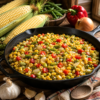
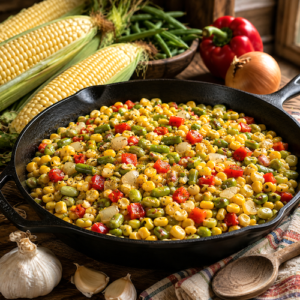
The Haudenosaunee Confederacy, made up of the Mohawk, Oneida, Onondaga, Cayuga, Seneca, and, later, Tuscarora peoples, occupied a homeland centered largely in what is now New York State, with communities and influence extending beyond today's political boundaries. They, like many of America's Indigenous Nations, sustained themselves on a diet centered on the Three Sisters—corn, beans, and squash—which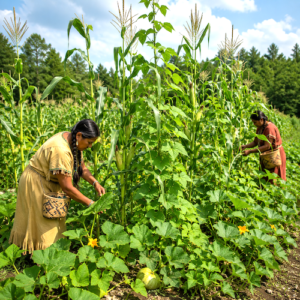 they cultivated together and which remain foundational to many dishes we continue to enjoy today, including corn soups, succotash, hominy, and cornbread.
Agriculture among the Haudenosaunee was a communal affair. Men generally cleared the fields, while women planted, tended, and harvested the crops. Even children participated, helping protect newly sown fields from birds, squirrels, raccoons, and other pests. Corn was more than simply another vegetable on the table. It could be dried and stored for winter, ground into meal, boiled into soups and porridges, or processed with an alkaline solution to make hominy, improving both its usefulness and nutritional value.
Many other foods we take for granted today were gathered, cultivated, or prepared by Indigenous people long before they became staples of the American kitchen. Take, for example, maple sugar.
Long before we poured maple syrup over a stack of pancakes, Native peoples of the Northeast were tapping maple trees as winter loosened its grip and the first signs of spring began to appear. Sap was collected and concentrated through evaporation, using methods that changed over time as different cooking vessels became available. Much of it was reduced beyond syrup into maple sugar, which was easier to store and transport. Made into cakes or granulated sugar, it became an important sweetener and seasoning that could be carried and used throughout the year.
 The forests supplied walnuts, hickory nuts, chestnuts, and other foods, while berries and wild plants added both variety and nutrition. Blueberries, strawberries, blackberries, and other fruits could be eaten fresh during their brief seasons or dried for later use. Hunting provided deer, turkey, rabbit, and other game. The result was not the monotonous diet sometimes imagined when we think of life before supermarkets and refrigeration, but one that changed with the seasons and made use of an impressive variety of foods.
Wampanoag: Where the Land Meets the Sea
Moving eastward to what is now Massachusetts brings us to the Wampanoag, whose traditional homeland included southeastern Massachusetts and the islands of Martha's Vineyard and Nantucket. The Wampanoag Tribe of Gay Head (Aquinnah), whose community remains on Martha's Vineyard today, represents a living continuation of those ancient coastal food traditions.
Here agriculture met the Atlantic.
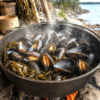
Corn, beans, and squash remained important, but so did the resources of the ocean, tidal flats, ponds, and rivers. Fish and shellfish were abundant. Clams, quahogs, mussels, oysters, and other shellfish could be gathered from coastal waters, while fish were caught according to their seasonal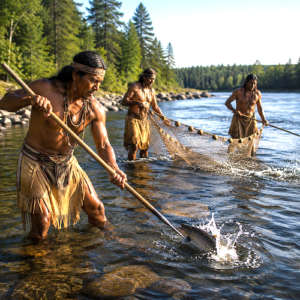 runs. That relationship continues today; the Aquinnah Wampanoag still manage a natural herring run where alewives return from the Atlantic each spring to reach their spawning grounds. Eel was another important food and could be caught in rivers and ponds, particularly during seasonal migrations.
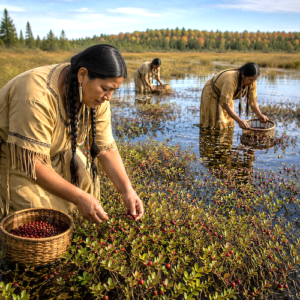
One of the Northeast's most recognizable native fruits was the cranberry. Long before cranberry sauce became practically inseparable from our modern Thanksgiving dinner, Native peoples were gathering the tart berries from bogs and wetlands. Cranberries could be eaten fresh, dried, or combined with other foods. Their importance, however, goes well beyond the Thanksgiving table we know today.
And then there is the clam.
Few foods seem more thoroughly New England than clam chowder, clam bakes, stuffed quahogs, and fried clams. Yet Europeans arriving on these shores entered a world where shellfish had already been harvested for generations. Archaeological shell middens along the Atlantic coast testify to just how important these foods were. The newcomers did not introduce New Englanders to clams; Native New Englanders introduced generations of newcomers to the abundance of the coast.
The Narragansett and Narragansett Bay
Across the waters to the west were the Narragansett, whose homeland centered around what is now Rhode Island and the waters of Narragansett Bay. Like the Wampanoag, they combined agriculture with fishing, hunting, and gathering. Corn, beans, and squash provided dependable cultivated foods, while the bay offered fish and shellfish in abundance.
 The Narragansett also occupy an important place in the colonial history of Rhode Island. After Roger Williams was banished from Massachusetts Bay, his relationship with Narragansett sachems, particularly Canonicus and Miantonomi, played an important role in his settlement at Providence. It is one of those uncomfortable intersections in American history where cooperation between Native people and European settlers was eventually followed by increasing pressure upon Native land and sovereignty.
King Philip's War of 1675–76 was particularly devastating to Indigenous communities throughout southern New England. Although the causes and alliances involved were complicated, the outcome was not: Native populations were killed, displaced, enslaved, or deprived of much of their land. The Narragansett suffered terribly.
Yet they did not disappear.
That bears repeating because for generations American history books too often wrote about Indigenous people as though they belonged only to the past. The Narragansett Indian Tribe remains a living Native Nation in Rhode Island, just as the other peoples discussed here remain living communities rather than characters from colonial history.
Penobscot and Passamaquoddy: Rivers, Forests and the Maine Coast
Farther north, in what is now Maine, the Penobscot and Passamaquoddy developed food traditions particularly suited to a country of forests, rivers, lakes, tidal waters, and a rugged coastline.
For the Penobscot, the river bearing their name was not simply a geographic landmark but a source of food and a route connecting communities and seasonal resources. Fish—including Atlantic salmon and other species—were important, as were game, berries, nuts, roots, and plants gathered from the surrounding forests.
The Passamaquoddy homeland along the waters of present-day eastern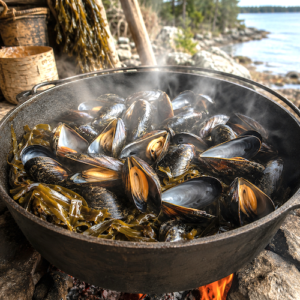 Maine and neighboring Canada likewise offered an extraordinary mixture of marine and woodland resources. Fish, shellfish, marine mammals in some contexts, game, berries, and other wild foods all contributed to the diet. Eels, which moved between fresh and salt water, were among the resources harvested from the region's waterways.
Blueberries deserve special mention. Maine is famous today for its small wild blueberries, but these berries were gathered by the region's Native peoples for generations before commercial blueberry barrens became part of the state's identity. They were eaten fresh and could also be dried for use after the short growing season had passed.
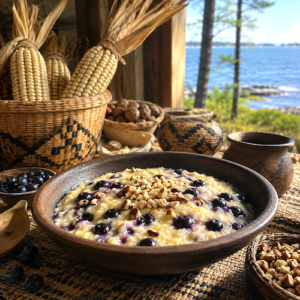
Blueberries also found their way into preparations such as sautauthig, in which dried berries were pounded and combined with parched cornmeal. Roger Williams described the dish as early as 1643. Later versions incorporated ingredients such as milk and sugar, illustrating yet another way Indigenous foods became adapted as Native and European food traditions intersected.
The same is true of many foods now marketed as regional specialties. Maple syrup, cranberries, blueberries, corn dishes, clams, oysters, and other foods have become deeply associated with New England cooking. Their Indigenous history is sometimes mentioned almost as a footnote. It should be closer to the beginning of the story.
Foods That Endured
Perhaps that is what has impressed me most while researching this series. Indigenous people did not merely survive on whatever happened to grow around them. They understood their environment and actively managed it. They planted and selected crops, harvested according to the seasons, preserved food for lean months, managed landscapes, fished rivers and coastal waters, and passed that knowledge from one generation to the next.
 Many of the ingredients we now think of as distinctly American were already being cultivated, harvested, cooked, and enjoyed centuries before there was a United States. Corn, beans, squash, maple, cranberries, blueberries, wild game and countless other foods did not suddenly become important when Europeans arrived. The newcomers were entering food cultures that were already ancient.
There is another part of this history that I find increasingly difficult to ignore.
While researching the four installments of this series, I have repeatedly encountered accounts of Native people sharing food, agricultural knowledge, hunting grounds, waterways, and survival skills with newcomers who knew little about the lands in which they found themselves. What followed that early contact is one of the more troubling chapters of our history.
European settlement brought diseases that killed Native people in staggering numbers. Treaties were made and broken. Land was taken through war, coercion, questionable agreements, and government action. Communities were displaced. Native children would later be taken from their families and sent to schools intended to strip them of their languages and cultures. Food traditions suffered as people were separated from ancestral hunting grounds, fishing waters, forests, and farmland.
I realize history is rarely simple, and I have no desire to judge people who lived centuries ago by pretending I completely understand their world. But neither do I believe we honor history by looking away from its unpleasant parts. The more I have learned while writing this series, the harder it has become for me not to feel a profound sadness and shame over how people who had lived on and cared for this land for countless generations were treated.
And yet, they survived.
So did the corn. So did the maple harvest. So did the gathering of berries,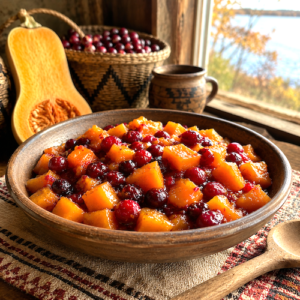 the fishing and shellfishing, the preparation of traditional dishes, and the knowledge attached to them. Across the Northeast, Native cooks, farmers, fishers, foragers, families, and cultural preservationists continue to maintain and reclaim food traditions that outsiders once assumed would disappear.
That may be the most important lesson with which to end this journey through Indigenous American foods. We should certainly remember where the ingredients came from and who first understood how to cultivate, gather, preserve, and prepare them. But we should also remember that Indigenous food is not merely a relic of America's past.
It is part of America's table still.