Doing Time at the Dinner Table
Food, Punishment, and Rehabilitation Behind Bars
For most of my life, I have thought about food in terms of nourishment, pleasure, hospitality, and the simple human connection that takes place when people sit down together to eat. As a chef, I have also spent a good portion of my career thinking about the practical side of feeding large numbers of people—budgets, nutrition, purchasing, preparation, food safety, labor, and the thousand other details that separate a meal on paper from the food actually placed on someone’s plate.
I never gave much thought, however, to what happens when the people being fed have virtually no choice about what, when, or how they eat. That changed when both of my sons spent time in prison. My oldest spent about three years in the Texas state prison system before being paroled. My youngest spent more than ten years in several federal institutions, including six years working in food service preparing meals for prison staff. Out of respect for their privacy, I have chosen not to identify them by name.
Their experiences caused me to begin asking questions I had never seriously considered before. What are we feeding the men and women we incarcerate? Is the food wholesome and nutritionally adequate? Is it safe? Does it preserve some measure of human dignity, or does food itself sometimes become another part of the punishment? And perhaps most importantly, if we expect incarcerated people eventually to return to society better prepared to live productive lives, does the way we feed them help accomplish that—or work against it?
I began this story with certain expectations. I had read horror stories about prison food—tiny portions, spoiled ingredients, powdered eggs, food being used as punishment, meals so inadequate that prisoners depended upon commissary purchases just to keep from going hungry.
Some of those stories have considerable evidence behind them. Others needed qualification. And a few simply did not resemble what one or both of my sons experienced.
That may be the first lesson I learned about prison food: there is no single American prison-food experience.
Two Brothers, Two Very Different Tables
I asked my sons essentially the same questions separately. I wanted their memories, not answers influenced by what the other brother had told me.
The differences were striking.
My youngest son surrendered to federal custody on a Thursday, too late for the evening meal. His first breakfast the following morning was probably oatmeal or grits; he no longer remembers which because, as he puts it, his mind was occupied by considerably more important matters.
What he does remember is that it had no taste.
Friday lunch was fish, something that became so familiar that prisoners had names for the two versions: “square fish,” a breaded fish patty, and “long fish,” a fillet. There would usually be two slices of whole-wheat bread, coleslaw, two packets of dressing, and perhaps rice, beans, or canned corn. Once a month, the fish came with macaroni and cheese, which was considered a treat.
Because the Federal Bureau of Prisons uses a National Menu, he encountered many of the same dishes as he moved through the federal system. What changed dramatically was how they were prepared.
At his first federal prison in the Deep South, he remembers food that was almost completely unseasoned. Beans were boiled in water and sometimes not rinsed well, occasionally leaving them tasting of dirt. At a later institution, he says the food was generally well seasoned and prepared with care.
“The biggest reason for the difference was the officer staff,” he told me. “While it’s true that inmates prepared the food for the compound, the prison staff set the standards.”
That observation interests me as a chef.
Give two cooks identical recipes and identical ingredients and you can still receive two very different meals. Institutional food is no different. A menu printed in an administrative office tells us what is supposed to be served. It does not tell us how carefully the beans were cooked, whether the vegetables were overdone, how long the eggs sat before service, or whether anybody gave a damn about the finished plate.
The Federal Bureau of Prisons' own Food Service Manual standardizes its food-service operations around a National Menu. Yet my youngest son's experience suggests that standardizing the menu does not necessarily standardize the meal.
My oldest son's Texas experience was different almost from the beginning.
Before reaching state prison, he spent time in a county holding cell. His memory of that food remains vivid.
“The food was sparse,” he told me.
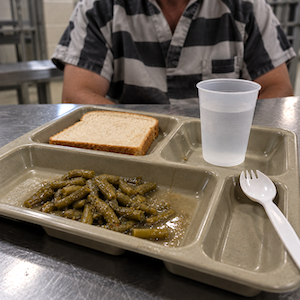 He remembers cold, unsalted green beans and initially leaving them on the tray. A choice that didn't take him long to reconsider.
“There was barely anything on the tray. But I remember that it didn’t take long to realize I needed to eat everything that came on the trays or I would be literally starving.”
He believes he lost about ten pounds during that week.
“By the end of it I was drinking the green bean water.”
Ironically, the first actual prison meal my oldest remembers was good. At a transport prison in Huntsville, he received what he remembers as a quarter chicken, potatoes, vegetables, and some sort of dessert.
“I ate everything on it and it was delicious,” he said.
That, however, was not what he remembers as normal prison food.
At the Texas unit where he spent most of his sentence, he recalls bland noodle casseroles, bland macaroni and cheese, bland mashed potatoes, and vegetables that varied according to the season. Some vegetables came from fields worked by prisoners themselves. In spring they could be quite good. By midsummer, he remembers them as overgrown and tough.
One advantage of working in those fields, he told me, was occasionally being able to eat something straight from the vine or out of the ground—provided you didn't get caught.
For him, the central problem wasn't merely taste.
It was hunger.
Going to Bed Hungry
When I asked my younger son whether federal portions were large enough, his answer surprised me.
“After a while, you get used to the portions and generally feel full.”
He ate his meals in the chow hall. Commissary food was mostly an occasional treat, and he has little patience with inmates who claimed that everyone needed money from home because the prison was starving them.
That doesn't mean his federal kitchens never ran short. After reading my first draft of this story, he reminded me that it occasionally happened. The difference, as he remembers it, was what happened next: the kitchen prepared more food, and the remaining prisoners were fed.
My oldest tells an almost opposite story about Texas.
“Most of the time you had to make a meal at your cell to go to bed full.”
He remembers occasions when the kitchen ran out of food before the last housing block was called to chow. Eventually, there were meals he didn't bother going down for. If his block was called late, he risked reaching the dining hall after food had run out, and the trip could interfere with count, shower time, telephone time, or other limited opportunities.
If he had commissary food, he ate in his cell.
If he didn't, he went hungry.
“Commissary is important if you didn’t want to be hungry,” he told me.
Even commissary wasn't guaranteed. You needed money on your account. You needed to get there when your housing block was permitted to shop. 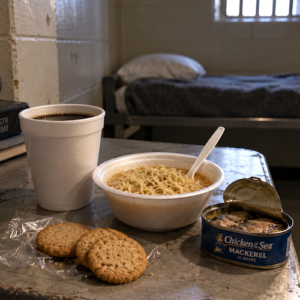 Lines could be long, other prisoners could cut ahead, and popular items could sell out.
He learned to ration what he had.
Sometimes dinner before bed was half a package of ramen noodles with a package of mackerel if he could afford it. In the morning, three cookies and black coffee might get him started.
Research suggests that my oldest son's feeling of hunger is not unique, although experiences vary widely. A 2020 national investigation by the nonprofit Impact Justice surveyed formerly incarcerated people and reported that 94 percent of its respondents said they couldn't eat enough in prison to feel full. Impact Justice is a prison-reform organization, and its survey should not be confused with a government nutritional audit or a nationally representative scientific sample. Still, the experiences it collected resemble my older son's account far more closely than that of the younger one.
The broader nutritional research presents a more complicated picture. A 2024 systematic review of quantitative studies of food in correctional institutions found that most menus studied met established recommendations for many macronutrients and micronutrients. Vitamin D tended to be inadequate and sodium excessive. The same review found that commissary foods were typically high in calories, sugar, fat, and sodium.
In other words, a prison menu can be nutritionally adequate on paper while an individual prisoner can still experience hunger, dislike the food, skip meals, supplement heavily from commissary—or encounter a kitchen that runs out before everyone has eaten.
A nutritional analysis of a menu and the lived experience of eating that menu are not the same thing.
When Flavor Becomes Contraband
One of the smallest details my sons told me may say as much about institutional eating as anything else.
Both learned that prisoners carried seasonings into the chow hall to make institutional meals more palatable.
My oldest son, assigned to a TDCJ unit, remembers salt and pepper sometimes coming from friends who worked in the kitchen and stole it for 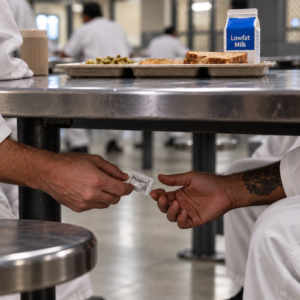 them. Other prisoners bought salt, pepper, hot sauce, and other condiments through commissary and sneaked them into the dining hall.
My youngest remembers federal inmates doing much the same thing.
Technically, bringing those items into the chow hall was prohibited.
Even flavor, apparently, could become contraband.
Texas prison commissaries today sell such things as salt and pepper, hot sauce, garlic powder, onion powder, and salt-free seasoning blends. Possessing seasoning isn't inherently remarkable. What is remarkable is the small act of reclaiming control represented by slipping it into a place where you are not supposed to have it.
Outside prison, if my eggs need pepper, I reach for the pepper.
Inside, even that simple choice can depend upon institutional rules.
About Those Powdered Eggs
Before beginning this story, I had encountered accounts describing prison scrambled eggs as “powdered eggs.” Being familiar with powdered eggs myself, that caught my attention. They are not an experience anyone could remember fondly.
So I posed the question to my youngest son.
He had worked in federal food service for six years. He knew what came into the kitchen and saw the packaging.
“The eggs were fresh shell eggs,” he told me.
Not powdered. Not frozen. Not liquid.
Fresh eggs.
Still, he hated the prison scrambled eggs because they were invariably overcooked.
There again is the difference between an ingredient and the food eventually served. You can begin with a perfectly good egg and still ruin it.
This doesn't prove that powdered, frozen, or liquid eggs have never been served in American prisons, nor does it tell us what every Texas unit used. It simply demonstrates why prison-food folklore needs to be checked before being repeated as fact.
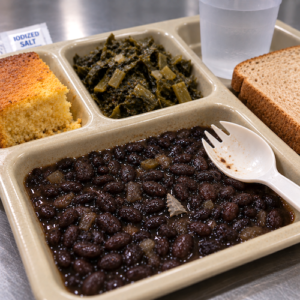 My son gave me another reminder of that difference between ingredients and finished food when he recalled the beans.
Once, while eating black beans, he bit down—or nearly bit down—on something that definitely wasn't a bean.
It was an arrowhead.
Not merely a pointed rock, he insists, but an honest-to-goodness, carefully shaped arrowhead, hard and sharp enough to do serious damage to a tooth.
How it found its way into a batch of institutional black beans, neither he nor I can explain.
But after spending more than forty years in professional kitchens, I have to admit that's one foreign object I have never encountered in a pot of beans.
The Prison Commissary Kitchen
Take away a conventional kitchen and cooks will still find a way to cook.
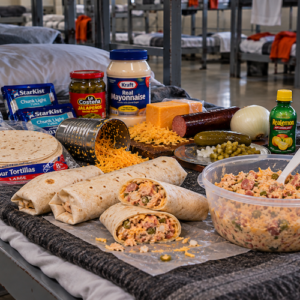
Prisoners combine commissary foods into dishes commonly called “spreads” or “bowls”—ramen noodles, chips, processed cheese, packaged meats or fish, pickles, jalapeños, and sauces combined in whatever way imagination and available ingredients permit.
Food also becomes currency. Both of my sons remember mackerel and ramen noodles being traded. Something purchased for eating could acquire an entirely different value when conventional commerce was unavailable.
And then there were the tamales.
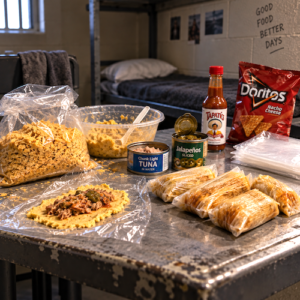 My younger son insists that prison tamales could taste remarkably like tamales on the outside.
They weren't produced by the prison kitchen. Prisoners made them themselves.
Corn chips were ground into powder to make a makeshift masa, then mixed with hot water. The water could be heated with an improvised heating device commonly called a “stinger.” Clean trash liners were cut into squares and used as wrappers. The masa was spread onto the plastic, topped with seasoned meats and vegetables bought through commissary—or, as my son corrected me after reading the first draft, stolen from food service—then rolled and steamed.
“They tasted the same as street tamales and were just as good.”
There is something wonderfully human about that.
Remove the kitchen. Remove the grocery store. Remove the stove. Restrict the ingredients and the utensils.
Somebody will still figure out how to make a tamale.
Food inside prison wasn't simply nutrition. It was memory, improvisation, and a connection with a world on the other side of the fence.
My youngest even developed what he jokingly calls his own signature prison dish: “tunaritos”—essentially tuna salad wrapped in a tortilla.
Nobody is likely to confuse it with haute cuisine.
That isn't the point.
Food and Community
Food creates communities outside prison, and it does the same thing inside.
My younger son remembers prisoners cooking and eating together as a bonding experience. When someone new arrived with virtually nothing, members of the group with which he associated might give him food and toiletries until he got established.
 He is careful not to romanticize this. Such generosity, he says, could be partly kindness and partly patronage. Prison alliances have their own relationships, expectations, and hierarchies. There can be power in numbers, and generosity can sometimes carry obligations.
My older son's experience was somewhat less communal. He shared commissary meals with small groups of men he trusted but doesn't describe the relationships as familial.
Both, however, remember holiday meals.
Thanksgiving and Christmas were different.
In the Texas system, those holiday meals meant larger portions, and inmates looked forward to them, sometimes planning how they would take meat back to their cells and turn it into something else. Church groups were also occasionally allowed to bring in food for special functions.
Those meals meant something to my son beyond calories.
“A nice meal from the church people made you feel loved and thought of,” he told me. “Not just some animal.”
That sentence stopped me.
As a chef, I have spent a lifetime feeding people. And there may be an important distinction between feeding somebody and cooking for somebody.
One satisfies hunger.
The other can communicate that somebody cared enough to prepare something worth eating.
Food Safety Behind the Walls
My older son also remembers circumstances that concern the chef in me.
He once found a piece of bone in ground meat that nearly broke a tooth. He recalls food handlers sometimes working without gloves and what he considered inadequate sanitation practices. There were periods when prisoners experienced diarrhea that he suspected was related to food being improperly held.
I cannot establish that the food caused those illnesses, and neither can he. His recollection is exactly that: a recollection, not a laboratory report.
But food safety in correctional institutions is a documented public-health problem.
In 2024, the Centers for Disease Control and Prevention reported that incarcerated and detained people were six times more likely than the general public to experience illness associated with a reported foodborne outbreak. Among the recurring problems identified during correctional outbreak investigations were failures involving time and temperature control.
An earlier CDC analysis covering 1998 through 2014 documented 200 reported foodborne outbreaks in correctional institutions, resulting in 20,625 illnesses, 204 hospitalizations, and five deaths. Food remaining at room temperature was the most frequently reported contributing factor among outbreaks for which such a factor was identified.
That does not prove what caused the stomach problems my oldest son remembers.
It does tell us his concern is not unreasonable.
TDCJ says its food-service operations are monitored for compliance with agency policies and procedures and that senior food-service managers receive ServSafe training. It also says its non-therapeutic inmate meals are designed to meet dietary guidelines and that regular, meat-free, and pork-free meals are available, along with therapeutic diets.
Again, there is a difference between policy and experience.
Both deserve to be part of the story.
Is Food Used as Punishment?
This was one of the questions I expected to answer differently.
Food has been used as a disciplinary tool in some American correctional settings, including the controversial blended meal commonly called “Nutraloaf” or disciplinary loaf.
Neither of my sons, however, describes food routinely being withheld as formal punishment.
According to my youngest, prisoners in federal segregation received essentially the same meals as everyone else, only delivered to their cells.
My oldest says much the same about segregation in Texas, although he remembers those meals as sometimes less hot or smaller.
Lockdowns were another matter.
When serious trouble occurred, he remembers thousands of peanut-butter-and-jelly sandwiches—or particularly miserable bologna sandwiches—being ready to feed prisoners when normal movement and food service were suspended.
But he does not describe this as a formal order to starve or punish inmates.
“Food was not generally used to punish as a directive from higher,” he told me.
That distinction matters.
I began this story expecting food-as-punishment to be one of its central themes. My sons' experiences don't support making it the centerpiece. Other prisoners and other institutions may have very different stories, and documented disciplinary feeding practices deserve acknowledgment, but I cannot honestly turn my sons' experiences into something they were not.
Same Institution, Different Table
Perhaps the strangest part of my younger son's federal experience occurred on the other side of the serving line.
At one institution, where the prison population fluctuated between roughly 1,300 and 1,600, he became one of four prisoners working in the officers' mess. They prepared meals for approximately fifty staff members a day.
Staff could eat the regular inmate meal or choose food prepared in the officers' mess.
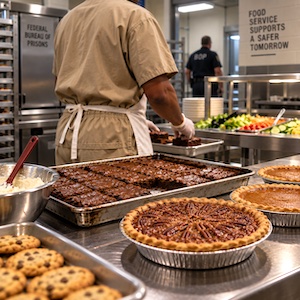 The inmate cooks used some of the same institutional ingredients available to the main kitchen, supplemented by fresh and specialty ingredients purchased specifically for the officers' mess.
The result was a very different meal.
There was a full-service salad bar with homemade dressings. There were fresh vegetables. There were scratch-made baked goods.
My son's specialties included lasagna, pasta, soups, and vegetable side dishes. He became the primary baker despite having entered prison with no baking experience.
He made pecan sandies, brownies, banana pudding, and sweet potato pies.
The staff loved them.
There is an unavoidable irony in an incarcerated man eating institutional meals and then walking into another kitchen to make scratch-baked desserts and carefully prepared food for the people employed to guard him.
But the story is more complicated than simply “good food for guards, bad food for prisoners.”
Feeding fifty people is vastly different from feeding fifteen hundred. The officers' mess had access to some ingredients the main kitchen didn't. The cooks had more freedom to plan an alternative menu. Scale, purchasing, staffing, security, and standardized-menu requirements all matter.
What interests me more is what happened to the cook.
When Cooking Becomes Rehabilitation
My youngest son did not enter prison as a baker.
He began working in food service after taking a ServSafe vocational class offered at the prison. That training helped him land the officers' mess job.
He stayed there six years.
When I asked what the work meant to him, I expected an answer about privileges. Kitchen workers could eat more, and that certainly mattered.
Instead, he talked about work.
“Some of my best memories of prison were of working in the officers’ mess because we were segregated from the rest of the compound, working with our hands, which was fulfilling—creating, experimenting, learning, and generally having a good time.”
Creating.
Experimenting.
Learning.
Those aren't words we ordinarily associate with incarceration.
They are, however, words I recognize immediately as a cook.
I know what it feels like to make something with your hands and watch another person enjoy it. I know the satisfaction of finally getting a recipe 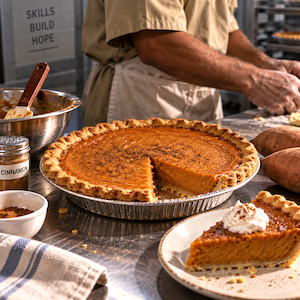 right. I know the pride that comes from discovering that you can do something today that you couldn't do yesterday.
My son found some of that behind prison walls.
And suddenly my original question—whether better prison food contributes to rehabilitation—seemed too narrow.
Perhaps the more interesting question is whether food itself can become part of rehabilitation.
Research into nutrition and prisoner behavior is intriguing but not conclusive. A 2024 systematic review examining dietary and nutritional interventions found some improvements in particular behavioral and cognitive outcomes, but the overall results were mixed and the researchers emphasized limitations in the available evidence.
We should therefore be cautious about claiming that serving better food will make prisons safer or reduce recidivism.
But rehabilitation isn't merely a biochemical response to nutrients.
It can also mean learning a skill.
Showing up for work.
Being responsible for something.
Working as part of a team.
Taking pride in a finished product.
Learning that other people depend upon you.
Texas itself has experimented with that idea. In a partnership between TDCJ and the San Antonio Food Bank, selected incarcerated people from two facilities received culinary instruction while helping prepare thousands of meals for children in community programs.
The concept isn't radical at all.
Give someone meaningful work and useful skills and perhaps he leaves prison knowing how to do something he couldn't do when he arrived.
One of my sons learned to bake.
“I Went From a Hero to a Zero”
My oldest boy experienced prison differently.
Before his arrest, he had been a police officer. Before that he served in the United States Army, reaching the rank of sergeant and completing two tours in Iraq.
When he entered prison, he did something he already knew how to do psychologically.
He went into what he calls “deployment mode.”
He had been away from home before. He had lived without ordinary comforts. He knew how to adapt to an institutional environment and get through the day.
Yet when I asked whether prison food ever made him feel less worthy of basic care, his answer couldn't have been more different from his brother's.
My younger son told me that prison had plenty of ways to make a person feel less than human, but food wasn't one of them.
The older one said:
“Everything about prison is designed to make you feel less worthy. You don’t even have a name. I went from a hero to a zero. The quality of food was just a reminder that you didn’t matter to anyone in the system.”
Two brothers.
Two prison systems.
Two answers to essentially the same question.
Neither answer proves what prison food does to everyone.
Together, however, they demonstrate why the subject cannot be reduced to calories, protein, sodium, or the cost of a tray.
A 2024 systematic review of qualitative research into prison food reached a similar conclusion from a much larger body of evidence. Researchers identified four recurring dimensions of the prison-food experience: appreciation of the food itself, logistics surrounding its preparation and distribution, variety, and relationships. Food could become a symbol of caring, power, or punishment.
A 2026 systematic review examining incarcerated people's subjective food needs identified four broad categories: practical, health, lifestyle, and self-determination needs. That last one seems particularly important.
Choice matters.
And prison is, by definition, a place where choice has been deliberately restricted.
The First Hamburger Home
Eventually, prison ends for most people.
My youngest son remembers his first meal after leaving federal prison because I was there.
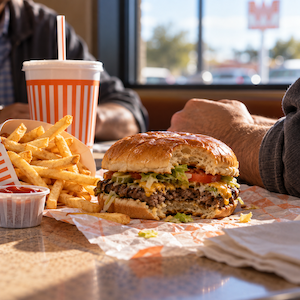 I picked him up and took him to Whataburger on our way to the halfway house.
After more than ten years of institutional portions, he ordered a hamburger and couldn't finish it.
It was simply too big.
“Absurdly big,” he remembers.
Then he had a thought I didn't expect.
“It made me wonder if it wasn’t the free world that had things backwards, not the prison.”
Eventually he readjusted to what he calls “street-food portions,” but the experience left him with an awareness of just how large our portions on the outside can be.
My oldest son was picked up by his girlfriend—now his wife—and doesn't remember his first meal as clearly. Release came during COVID, complicating everything. He remembers a barbecue meal sometime afterward, but what he remembers more vividly is finally taking a decent hot shower and worrying about the ankle monitor attached to him.
Food wasn't necessarily the first thing either man cared about once the gate opened.
Perhaps that should tell us something too.
More Than What's on the Tray
I began researching prison food because I wondered whether bad food might interfere with rehabilitation.
I no longer think the question is that simple.
There are certainly legitimate concerns about prison nutrition and food safety. There are documented correctional foodborne outbreaks. Research has identified excessive sodium and other nutritional shortcomings in some institutional menus. Formerly incarcerated people have reported hunger, poor-quality food, and dependence upon commissary purchases.
Those problems shouldn't be dismissed.
But neither should we pretend every prisoner has the same experience.
My younger son tells me he was adequately fed most of the time, generally liked the food at one federal institution, never considered food part of his dehumanization, and thinks some prisoners exaggerated their need for commissary food. Even when his federal kitchen occasionally ran short, he remembers additional food being prepared.
My older son tells me he regularly worried about getting enough to eat, depended upon commissary when he could afford it, encountered a Texas chow hall that sometimes ran out of food, and regarded poor food as one more reminder that he no longer mattered.
Both can be telling the truth.
Perhaps that's because the quality of prison food depends on more than the menu.
It depends upon the institution.
The administration.
The people supervising the kitchen.
The incarcerated people doing the cooking.
The ingredients actually available that day.
The time allowed.
The temperature at which the food is held.
And, perhaps most importantly, whether anybody involved believes the people eating it deserve a meal prepared with some degree of care.
Prison is punishment. There is no getting around that. People are deprived of liberty because society has determined they committed crimes serious enough to warrant incarceration.
But deprivation of liberty is the sentence.
We still have to decide what we expect to happen during those years behind the fence.
If the only objective is punishment, then perhaps food need be nothing more than enough calories and nutrients to keep a person alive.
If we expect something more—responsibility, education, vocational skills, changed behavior, and eventually successful return to society—then perhaps food deserves to be considered part of that environment too.
Not because a well-seasoned plate of beans will rehabilitate somebody.
It won't.
But because food does things beyond feeding us.
It creates routine. It creates community. It carries memories of home. It becomes currency. It can communicate power. It can communicate indifference. And sometimes it can communicate care.
In prison, men grind corn chips into masa and figure out how to make tamales without a kitchen. They slip hot sauce into a chow hall because even when almost every choice has been taken away, they still want some say over how their food tastes. They share ramen and mackerel with men who have nothing. They look forward to Thanksgiving because for one day the tray might hold a little more than usual.
One of my sons remembers drinking the water from cold green beans because he was hungry.
The other learned to make sweet potato pie from scratch.
Those two experiences took place inside American prisons.
Somewhere between them is the story of what it means to feed the people we incarcerate.
And perhaps what we feed them tells us something about what we expect them to become when they come home.