American Goulash: From Old World Kettle to Mid-Century Supper Table
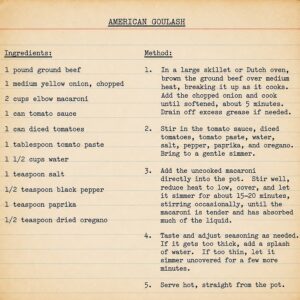
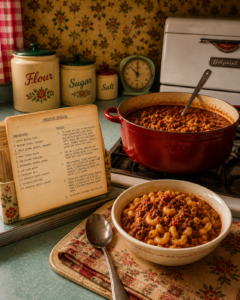
My mother, one of eight siblings raised on a farm in southeastern Oklahoma, was a fantastic, albeit simple cook. And like most housewives of the fifties and sixties, she tried to stay up on the latest cooking trends through Better Homes & Gardens and Southern Living magazines. One of her frequent creations was goulash, a family favorite and one my father referred to as Italian—with strong emphasis on the “I”—macaroni and meat sauce. Where she got the recipe—maybe from a magazine, maybe from a friend at church—no one really knows. I recently ran across it typed on an index card in the envelope of her recipes I was rummaging through.
American goulash, sometimes referred to as slumgullion, likely owes its origin to Hungarian goulash. About the only thing the two dishes have in common is that they both contain meat and paprika. In fact, some versions of American goulash do not call for paprika at all.
To understand how we got from one to the other, you have to go back a good long ways—far beyond my mother’s kitchen, beyond 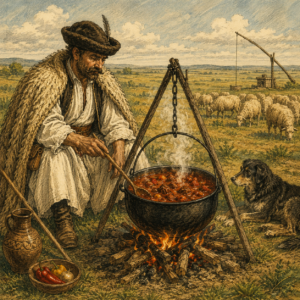 church suppers and magazine recipes, to the wide plains of Hungary. There, in the 9th century, Magyar shepherds prepared a dish known as gulyás, a simple stew of beef, onions, and whatever seasonings were available, cooked slowly in a kettle over an open fire. Paprika, now so closely associated with Hungarian cooking, didn’t even arrive until the 16th century, after peppers made their way to Europe from the New World.
Over time, gulyás evolved into a national dish of Hungary—rich, deeply flavored, and more akin to a soup or stew than anything we would recognize today as “goulash” in America. It was hearty food, designed to sustain hard-working people, and it carried with it a sense of place, tradition, and identity.
Like so many Old-World dishes, goulash made its way to the United States with immigrants in the 19th and early 20th centuries. Hungarian immigrants brought their recipes and techniques with them, settling primarily in the industrial cities of the Midwest and Northeast. But as often happens, the dish began to change almost immediately.
 Ingredients were adapted to what was available. Cooking methods were simplified. And perhaps most importantly, the dish began to merge with other culinary traditions already taking root in America. By the time goulash reached the broader American home cook—particularly in the years following World War I—it had already begun its transformation.
Somewhere along the line, tomatoes entered the picture. This was not traditional in Hungarian goulash, but tomatoes were abundant, inexpensive, and increasingly popular in American kitchens. Pasta followed close behind, likely influenced by Italian-American cooking, which was gaining a strong foothold in cities and filtering into the mainstream through restaurants, community cookbooks, and eventually magazines.
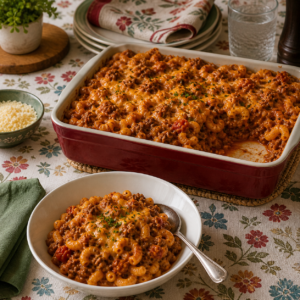
By the time you get to the 1930s and 1940s, what we now call American goulash was starting to take shape: ground beef instead of stewing meat, macaroni instead of potatoes or dumplings, and a tomato-based sauce that owed as much to Italian gravy as it did to anything Hungarian. It was a one-pot meal—economical, filling, and easy to prepare.
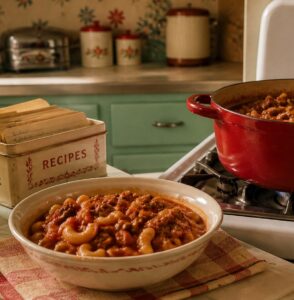 During the Great Depression, dishes like this became essential. Stretching a pound of ground beef to feed a family of six or eight was not just practical—it was necessary. Pasta and tomatoes provided bulk, while onions and simple seasonings added flavor. It was the kind of cooking that relied less on tradition and more on ingenuity.
And then came the postwar years—the very era in which my mother was cooking. Convenience foods were on the rise, but so was the idea of the home-cooked family meal. American goulash fit neatly into both worlds. It could be made from scratch, simmered slowly on the stovetop, or it could be adapted using canned tomatoes, tomato soup, or even pre-packaged seasoning mixes.
It was also endlessly flexible. Some cooks added bell peppers, others corn. Some used garlic, others didn’t. Cheese might be stirred in at the end or sprinkled on top. Paprika came and went depending on the cook’s preference—or whether it happened to be in the pantry that day.
That flexibility is part of what allowed American goulash to become so widespread. It wasn’t bound by strict rules or regional identity. Instead, it became a reflection of the home cook—each version slightly different, each one shaped by memory, availability, and taste.
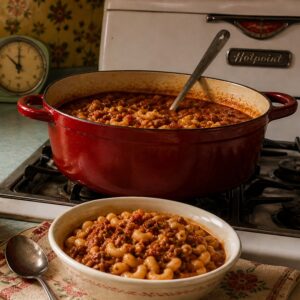 In our house, it was simple: ground beef, elbow macaroni, tomatoes, and a handful of seasonings. I don’t recall my mother ever measuring much of anything. She cooked by instinct, by feel, by what looked right in the pot. And when it was done, it was ladled into bowls and served hot, usually with a slice of buttered bread on the side.
My father’s description—“Italian macaroni and meat sauce”—wasn’t entirely wrong. By the time American goulash reached our table, it had traveled a long way from its Hungarian roots, picking up influences and shedding others along the way. What remained was something uniquely American: a dish born not from tradition alone, but from adaptation.
Today, American goulash still shows up on dinner tables, in school cafeterias, and at church potlucks across the country. It may not carry the same sense of heritage as its Hungarian ancestor, but it carries something else just as meaningful—a sense of home.
And maybe that’s the point.
 Because for all its wandering—from shepherd’s kettle to farmhouse kitchen to suburban stovetop—goulash has always been about feeding people. Not just filling them up, but bringing them together. It’s the kind of dish that doesn’t ask much of the cook, but gives plenty in return.
That old index card I found—typed, slightly yellowed, edges worn from years of use—didn’t just hold a recipe. It held a piece of our family’s story. And like the dish itself, it’s been passed along, changed a little here and there, but never forgotten.