The Breakfast I Thought Had Always Been There
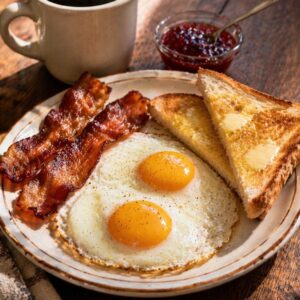
How Bacon and Eggs Became an American Standard
As far back as I can remember, bacon and eggs were my family’s go-to breakfast. That’s not to say that we didn’t enjoy other morning meals, because we did. Every now and then there might be a bowl of hot oatmeal or cold cereal, pancakes or waffles, or French toast smothered in maple-flavored syrup—I didn’t taste real maple syrup until I was grown—sometimes molasses, sometimes white Karo syrup.
Most mornings, though, breakfast came with toast, or occasionally canned biscuits (I don’t remember my momma ever making scratch biscuits), and white country gravy. Now and then sausage patties would stand in for the bacon. But those changes were rare indeed. The steady rhythm of our table was bacon and eggs.
We even had bacon and eggs for supper a few time a month. After all, bacon and eggs made for a substantial and economical meal—filling, familiar, and always within reach.
For years I took that pairing for granted, as if it had always been there, waiting at the edge of the skillet. But at some point the question began to nag at me: When did bacon and eggs become breakfast food? And maybe just as important—when did we begin eating breakfast the way we do at all?
How it all began
Humans have been eating eggs for thousands of years, long before chickens were domesticated. Wild bird eggs were  gathered wherever they could be found. The domestication of the chicken is generally traced to Southeast Asia, likely as early as 1500–2000 B.C.E., with early evidence appearing in India and spreading to China and Egypt not long after.
Bacon—at its most basic, cured pork—has a similarly ancient lineage. The Chinese were salting pork bellies as early as 1500 B.C.E., and the Romans later refined curing techniques and carried them throughout their empire. By the Middle Ages, the word bacoun in England referred broadly to pork, not just the specific cut we think of today.
In ancient Rome, people commonly ate three meals a day. The first, ientaculum, was a modest breakfast that might include bread, fruit, and, when available, eggs. But after the fall of the Roman Empire, attitudes toward breakfast shifted. In much of medieval Europe, religious and medical authorities discouraged eating early in the day, associating it with gluttony. Exceptions were made for children, the elderly, and laborers—those who needed sustenance to face physical work.
Even then, the morning meal, when taken, was simple: coarse bread, pottage, or porridge.
By the 17th century, opinions began to soften. English physician Tobias Venner recommended a light but restorative breakfast, suggesting poached eggs with salt, pepper, and vinegar, served alongside bread and butter. Around the same time, The Closet of Sir Kenelm Digby Knight Opened advised “two new-laid eggs” for breakfast.
Eggs, it seems, were quietly working their way back into the morning.
As for bacon, it often appeared alongside eggs by the 17th and 18th centuries, though it was only one of many possible accompaniments. It wasn’t yet the defining partner we think of today.
Breakfast comes to America
Chickens arrived in the Americas by several routes—brought by European colonists, traded through Africa, and possibly even  introduced earlier in parts of South America. Pigs came later. While Juan Ponce de León is often credited with bringing swine to Florida in 1521, it was Hernando de Soto who, in 1539, landed with a small herd that multiplied quickly and spread throughout the southeastern colonies.
In colonial America, neither eggs nor bacon were confined to breakfast. Eggs were an “anytime” food—appearing at breakfast, dinner, or supper as needed. Pork, in its many preserved forms, was a staple protein, valued for its keeping qualities as much as its flavor.
Colonial mornings began early, often before sunrise, and breakfast—if taken at all—was practical rather than ceremonial. For farmers and laborers, it might be a mug of cider or beer and a bowl of porridge or cornmeal mush sweetened with molasses. In towns and cities, those with means might enjoy bread, cold meats, pastries, or fruit pies, accompanied by coffee, tea, or cider.
Eggs gradually became more common at the breakfast table, but they shared the stage with a wide range of foods. There was no fixed idea yet of what breakfast should be.
Enter public relations
By the late 19th and early 20th centuries, American eating habits had begun to shift. Industrialization changed work patterns, urban living altered routines, and lighter breakfasts—coffee and a roll, perhaps—became common.
Then came Edward L Bernays.
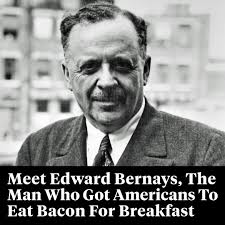 In the 1920s, the Beech-Nut Packing Company hired Bernays to increase sales of bacon. Rather than simply advertising the product, he set out to reshape the way Americans thought about breakfast itself.
Consulting with a physician, Bernays promoted the idea that a hearty breakfast was healthier than a light one. He then persuaded thousands of doctors to publicly endorse this view—framing bacon and eggs as the ideal morning meal. Newspapers and magazines eagerly picked up the story, and what followed was a dramatic shift in public perception.
It wasn’t just advertising—it was persuasion at scale.
Bernays’ campaign is still studied today as a defining example of modern public relations: the use of trusted third-party voices to validate an idea and influence behavior. And in this case, it worked remarkably well.
Bacon and eggs, once just one of many combinations, became the America breakfast.
The breakfast we remember
Today, eggs are more than just a part of the American breakfast—they are often the centerpiece. Scrambled, fried, poached, or  boiled, they remain unmatched in versatility, nutrition, and comfort.
And bacon—crisp, duty, unmistakable—still finds its ay alongside them, just as it did on my family’s table all those years go.
Looking back, I realize that what felt timeless was, in fact, carefully constructed—shaped by history, habit, and even a bit of clever persuasion. But that doesn’t make it any less real.
Because in the end, breakfast isn’t just what we eat.
It’s about what we remember.