Before the Settlers’ Pantry: Six Indigenous Foods That Sustained the American Continent
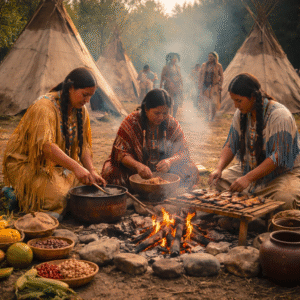
Having been born in southeastern Oklahoma’s Pushmataha Valley—the heart of the Choctaw nation—I’ve always carried an inherent curiosity about Native peoples, their lives, and especially their foods. The land there still holds stories if you know how to listen. This article is my attempt to listen a little more closely.
Long before the settlers and their well-stocked mercantiles, before cast-iron stoves warmed winter kitchens, before sugar tins rattled in cupboards, this land already knew how to feed its people. Across forests, prairies, rivers, and deserts, Indigenous communities developed foods that could withstand hard travel, lean seasons, bitter cold, and long journeys by canoe or on foot. There were no printed labels, no measuring spoons, no standardized recipes—only observation, patience, and knowledge carried forward from one generation to the next.
These were not makeshift provisions born of desperation. They were deliberate, refined, and deeply ingrained in daily life: meat dried and bound with fat for endurance, corn parched for the trail, acorns leached into nourishing meal, rice knocked gently from canoes at harvest, salmon cured for winter, roots slow-roasted beneath the earth. Long before settlers built pantries of their own, America’s first peoples had already mastered the art of survival—and, more importantly, the art of living well within the rhythms of the land.
Pemmican
Pemmican was a concentrated source of nourishment designed to sustain hunters, traders, and travelers through long winters and 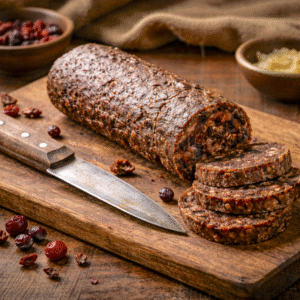 even longer journeys.
At its most basic, pemmican is made from lean meat—traditionally bison on the Plains, though deer, elk, or moose were also used in other regions. The meat was sliced thin and dried thoroughly, either in the sun or over low heat, until it became brittle. It was then pounded into a coarse powder. That dried meat was mixed with rendered fat (often tallow) in roughly equal proportion, creating a dense, shelf-stable mixture. In many regions, dried berries such as juneberries, chokeberries, or cranberries were added for flavor and subtle sweetness.
The mixture was pressed into cakes or packed tightly into rawhide bags, where it could keep for months—sometimes years—if stored properly. It required no cooking and could be eaten as-is or crumbled into soups and stews for added richness.
In today’s world of modern tastes, pemmican may sound austere, but it was anything but primitive. It was portable, calorie-dense, and remarkably efficient—so much so that later fur traders and explorers adopted it as a staple ration. It was sustenance born not from a package, but from deep understanding of the land and wise use of what it provided.
Acorns
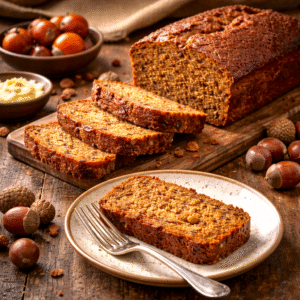 For many Native peoples—particularly in California, Arizona, and across the Southwest—acorns were not merely a fallback food for hard times but a foundational staple.
While acorns are nutritious and abundant, they contain bitter tannins that must be removed before consumption. The careful processing methods developed to make them edible stand as a testimony to generations of ecological knowledge.
Acorns were harvested in the autumn as they ripened and fell from the trees. After cracking the shells and removing the nutmeats, The acorns were ground into meal and placed in finely woven baskets. Water was poured over the meal and allowed to seep through, sometimes repeatedly over several days, leaching out the tannins. In other regions, the meal was soaked and the water changed multiple times until the bitterness was gone.
Once leached, the acorn meal could be cooked into porridge, shaped into cakes, thickening soups, or baked into breads. Properly dried and stored, acorn flour could last many months and sometimes longer, providing reliable nourishment through the winter.
Even the byproducts were used. Crushed cupules and shells were sometimes mixed into clay to temper pottery clay. The tannin-rich leaching water left found medicinal and practical uses. Little was wasted. In that careful stewardship lies one of the great lessons of Indigenous foodways: food was not simply gathered; it was understood.
Parched Corn
Parched corn—dried kernels, often flint corn, toasted over coals—was a lightweight, durable travel food that took many forms.
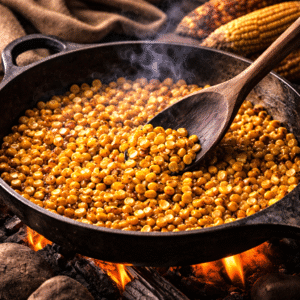 It could be eaten as a crunchy snack, not unlike modern corn nuts. It could also be boiled in hardwood ash to loosen the hulls, then dried again and ground into a versatile meal. Mixed with water, it made a quick sustaining drink. Added to soups, it thickened and enriched them. Combined with meat and fat, it strengthened travel rations.
Some tribes simply ground the roasted corn without the ash treatment. The resulting meal was known by various names, including nokehig, rockahominy, or pinole, depending on region and language.
Lightweight and resistant to spoilage, parched corn was ideal for long journeys, hunting expeditions, and winter stores. It represents an early mastery of preservation—transforming fresh harvest into something durable without sacrificing nourishment.
Manoomin (Wild Rice)
Manoomin—meaning “the good berry” in Ojibwe—is a native wild rice and a sacred food of the Anishinaabeg peoples (also known as Ojibwe or Chippewa) of the Great Lakes region.
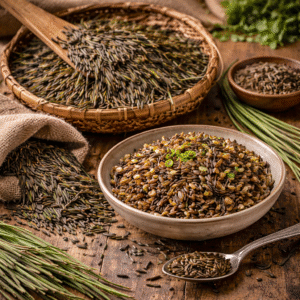 Traditionally harvested by hand from canoes, one person would gently bend the tall grasses over the canoe while another used wooden sticks to knock the ripe grains free. The rice fell into the boat, while enough grain remained to reseed the waters. It was then parched over wood fires, hulled, and winnowed to remove the chaff.
Manoomin is high in protein, fiber, and minerals, but its value extends far beyond nutrition. It is central to Anishinaabe migration stories and identity. For generations, it sustained communities through long northern winters.
It should not be confused with commercial paddy-grown “wild rice,” which differs in species and flavor. In recent years, tribal nations have worked diligently to protect and restore wild rice beds threatened by pollution, fluctuating water levels, and development. In preserving manoomin, they are preserving culture itself.
Dried Salmon
For Indigenous peoples of the Pacific Northwest, salmon was—and remains—deeply woven into the fabric life.
 Each year, salmon species such as chinook, sockeye, coho, chum, and pink return from the ocean to the freshwater streams where they were born. During these spawning runs, communities harvested them using nets, weirs, traps, and spears—methods refined over centuries.
Oral traditions tell that salmon offered itself to sustain the people, and in many tribes the First Salmon Ceremony honors that gift. Such stories reflect a reciprocal relationship: if the salmon were respected, they would continue to return.
To preserve the abundant seasonal catch, salmon was often wind-dried. After cleaning and filleting, the fish were cut into strips and hung on racks to dry in circulating air. Another common method was smoking, which both preserved the fish and enriched it with flavor.
One traditional way of preparing the catch is known as wind-drying. The head and bones were removed from the salmon, the meat cut into strips, then salted and hung to dry for several days. Another popular method of salmon preservation is dry smoking it.
Villages were often located near prime fishing sites, and rights to those sites carried social and political significance. Today, dams, habitat loss, and overfishing challenge salmon populations, raising concerns not only about food security but about cultural continuity.
Camas Bulbs
The violet-blue camas flower hides beneath it a bulb that was once a vital carbohydrate source for many Northwest tribes.
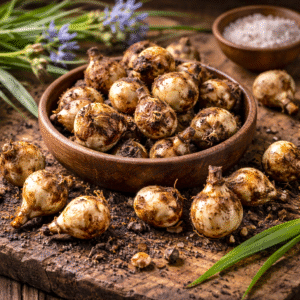 Resembling a small cross between a garlic clove and a potato, camas bulbs were harvested, traded, and carefully managed in meadow ecosystems. They were often slow-cooked in underground earth ovens for many hours—or even days. This long cooking converted inulin into natural sugars, turning the bulbs dark and giving them a surprisingly sweet flavor.
When cooked briefly, camas can taste mild and starchy. But when traditionally slow-roasted, they become richly sweet, almost fig-like in character.
Although no longer a daily staple, camas remains culturally and spiritually meaningful. Tribes today are restoring camas meadows and teaching younger generations the proper methods of harvesting and preparation—ensuring that knowledge does not disappear.
The foods in this article were not curiosities of a distant past. They were—and in many communities still are—expressions of relationship: between people and place, season and survival, respect and reciprocity.
I hope you’ve enjoyed reading about six foods that sustained the peoples who first inhabited this continent. In the coming weeks, I would like to explore additional Indigenous foods—not as relics, but as living traditions that continue to nourish both body and memory.