Grandma’s Kitchen: Before Convenience Came to the Table
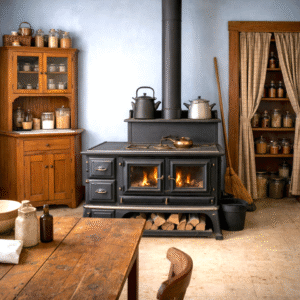
Today while baking bread, my mind wandered back to my early childhood and visits to my grandma’s farm, where I would sit and watch as she prepared the breakfast biscuits. And though I remember being in awe of the huge black wood-burning stove that dominated her kitchen, the lack of other modern furnishings went unnoticed until much later in my life.
Let me regress for a moment to explain that until I reached my early teens, Grandma lived on the same southeastern Oklahoma farm where she and Grandpa raised my mom and her eight siblings. There was no running water, no indoor plumbing, and no natural gas.
Water was hand-drawn from a well next to the smokehouse (which I don’t remember ever being used for anything but storage), located some twenty feet from the main dwelling’s back door. And while she had two toilets, they were both outdoor privies—one in the chicken yard for women, the other out by the cow lot for men.
The screened-in back porch (which for years I thought was the front porch) ran the width of the house and doubled as a food 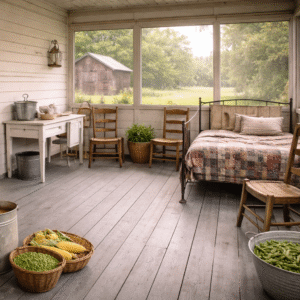 prep area for shelling corn and peas, snapping beans, and churning soured milk into butter. At either end was a huge iron bed used for grandkids—or sometimes Grandma on summer nights when it was too hot to sleep in one of the three interior bedrooms. That porch was also where we bathed in a large galvanized tub, with water heated on the kitchen stove.
When I was about six or seven years old, three of my uncles chipped in to have a large butane tank installed out by the men’s privy, so Grandma could trade her old wood-burner for a brand-new OTASCO (Oklahoma Tire and Supply Co.) butane range. I still recall how proud she was to finally have a modern stove on which to cook the daily meals.
Have you ever wondered what the household kitchen was like in the 1920s and ’30s—and how far it has come over the last 100 years? Let’s explore that thought.
The nineteenth century’s industrial age brought with it a number of social and technological advances that changed the lives of many American housewives. Kitchens went from austere, rather 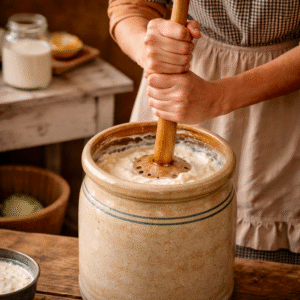 utilitarian spaces in both appearance and function to rooms with painted walls—often green or gray—wainscoting, cabinets with glass doors, dry sinks, and freestanding work tables. And while gas ranges became available later in the century, many cooks, like my grandmother, were logistically bound to—or simply preferred—their large wood- or coal-burning stoves. Even with these advances, kitchens were still built primarily for production rather than efficiency or comfort.
By the early twentieth century, the reduced availability of household labor—along with shifting social and economic realities—placed new demands on the American kitchen. Home economists and so-called “efficiency experts” began studying workflow, much the way factories studied assembly lines. Their findings reshaped the kitchen into a smaller, more organized space, where steps could be saved and labor reduced. Built-in cabinets replaced scattered furnishings, work surfaces were standardized, and sanitation became a guiding principle rather than an afterthought.
But for all the talk of efficiency, much of rural America—places like my grandmother’s farm—continued on in ways that would have been familiar decades earlier.
The Working Kitchen
In those kitchens, every object had purpose—and most had more than one.
The icebox, for instance, was not the quiet, humming appliance we know today, but a wooden cabinet lined with zinc or tin, cooled by a block of ice delivered to the home, usually on a weekly basis. It sweated in the summer heat, its drip pan needing regular attention, and it demanded careful planning. Milk, butter, 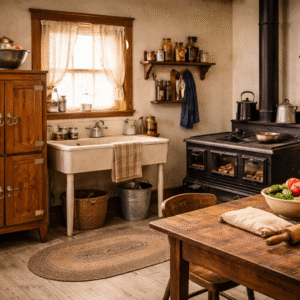 and fresh meat occupied the coldest space nearest the ice, while leftovers—if there were any—were tucked wherever they might keep.
Nearby stood the Hoosier cabinet, a marvel of its time and perhaps the closest thing to a “kitchen workstation” before the modern era. With its flour bin, built-in sifter, sugar drawer, and enameled wooden work surface, it gathered the tools of baking into one efficient unit. For women like my grandmother, it was less a convenience and more a command center—everything within arm’s reach, everything in its place.
Mixing was done by hand, or with a hand-cranked egg beater whose steady rhythm became part of the kitchen’s music. Butter was churned not by machine, but by persistence—cream in a stoneware butter churn worked with a wooden dasher until it separated into butter and buttermilk. Even the simplest tasks required time, strength, and patience.
And then there was the stove—the heart of it all.
A wood- or coal-burning range demanded constant attention. Fires had to be built, fed, and managed. Temperature was judged not by dial but by instinct—by how quickly flour browned in a pan or how fiercely a drop of water danced on the surface. It heated the kitchen in winter and punished it in summer, yet it was indispensable, not only for cooking but for heating water, drying clothes, and warming the house.
The sink, when there was one, was often little more than a basin with a drain—fresh water carried in by hand, wastewater carried out the same way. Dishes were washed in stages: wash water, rinse water, then dried by cloth or air. Nothing was wasted. Nothing was easy.
And yet, nothing felt incomplete.
The Modern Shift
Over the past century, the kitchen has undergone a transformation more dramatic than than just about any other room in the house.
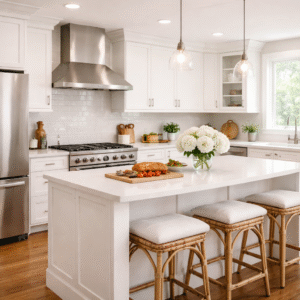 Electricity brought with it refrigeration that no longer depended on deliveries or melting ice. Electric mixers replaced the hand-cranked ones. Gas and electric ranges provided consistent, controllable heat. Running water turned the chore of washing into a simple task, and eventually dishwashers took even that away.
Cabinets became built-in, countertops continuous, and kitchens opened up—not just physically, but socially. What had once been a workspace hidden from view became the center of the home—a place where cooking, conversation, and daily life all came together.
Today’s kitchens are, by comparison, marvels of convenience. With the push of a button, we can preheat an oven, blend a sauce, or chill a drink. Ingredients arrive from across the country—or the world—ready to use, requiring little more than assembly.
And yet, something of the old ways still lingers.
What Remains
When I think back on my grandma’s kitchen, I don’t remember inconvenience. I remember rhythm.
I remember the sound of biscuit dough being worked by hand, the scrape of flour on a wooden surface, the low crackle of a stove 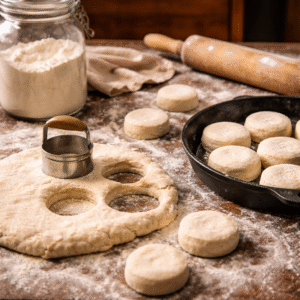 that had been burning since before sunrise. I remember the quiet order of it all—how each task followed another, not rushed, but steady and sure.
Those kitchens demanded more, certainly. More time. More effort. More patience.
But in return, they gave something we are still chasing today—a sense of connection. To the work. To the food. And to the people gathered around it.
And perhaps that is the true evolution of the kitchen—not just the tools we use, but how we understand them.
Because even now, standing in a modern kitchen with every convenience at hand, I sometimes find myself drawn back—not to the hardship, but to the simplicity. To a place where a stove was more than an appliance, and a kitchen was more than a room.
It was, in every sense, the heart of the home.