At the End of the Irish Rainbow Lies a Pot of Culinary Gold
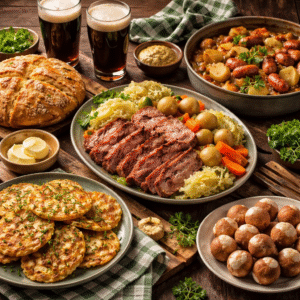
One surprising thing I learned while researching my Scots-Irish heritage is the many wonderful foodstuffs Irish immigrants introduced to America, some of which are no longer strongly associated with them. Key agricultural contributions included potatoes, turnips, rhubarb, and rutabagas. They also brought expertise in distilling techniques, transforming American grains into rye whiskey and moonshine. Other influences included meat curing, soda bread, buttermilk, and boiled dinners.
With St. Patrick’s Day coming up, I thought we might explore what the holiday brings to America’s foodways. But before we go there, let’s take a look at some facts concerning St. Patrick’s Day and how it evolved in this country.
 While St. Patrick became the patron saint of Ireland, he was not Irish. He was actually born into a fourth-century British Christian family. At age sixteen, Patrick was captured by Irish pirates, sold into slavery, and spent the next six years working as a shepherd. During this time, his Christian faith deepened. At age twenty-two, Patrick escaped his captivity and returned home, where he studied to become a priest and later a bishop before returning to Ireland as a missionary.
History tells us Patrick spent years traveling the countryside, preaching and establishing churches. By the time of his death—placed on March 17, 461 AD—he had become deeply associated with the spread of Christianity throughout Ireland. Centuries later, that date became a feast day honoring his life.
For most of its history in Ireland, St. Patrick’s Day was a quiet religious observance rather than the festive public celebration we know today. Families attended church services, perhaps enjoyed a modest meal, and that was about the extent of it. The pubs were often closed, and public revelry limited.
St. Patrick’s Day comes to America.
 Irish immigrants began arriving on these shores in significant numbers during the eighteenth century, with the largest wave occurring during the mid-nineteenth century after the Great Famine. They brought with them traditions, music, stories, and of course their foodways. Like many immigrant groups, they also brought a deep desire to maintain their identity in a new and unfamiliar land.
Public celebrations of Irish heritage became a way of doing just that.
One of the earliest St. Patrick’s Day parades in what would become the United States reportedly took place in New York City in 1762, organized by Irish soldiers serving in the British Army. By the nineteenth century, Irish immigrants and their descendants were celebrating March 17 with parades, music, and gatherings that affirmed their cultural pride.
Over time, the holiday grew well beyond its religious roots. In America, St. Patrick’s Day gradually became both a celebration of Irish heritage and a broader cultural event—one where food and drink naturally played a central role.
That brings us to the kitchen.
Irish and Scots-Irish immigrants contributed far more to American cooking than most people realize. Their influence often blended so thoroughly into the larger culinary landscape that many dishes no longer seem distinctly Irish at all. Yet if you follow the trail back through time, you will find their fingerprints on many of the foods we still cook today.
Take the humble potato, for instance.
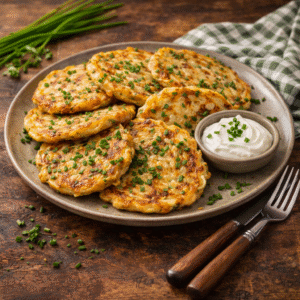 Although potatoes originated in South America, it was the Irish who embraced them so fully that they became inseparable from the country’s identity. When Irish immigrants arrived in North America, they naturally carried their knowledge of cultivating and cooking potatoes with them. In rural settlements across Appalachia and the American frontier, the potato became an important staple—easy to grow, filling, and adaptable to many dishes.
Boiled, mashed, or tucked into hearty stews, potatoes fit neatly into the practical, no-nonsense cooking style that characterized Irish kitchens.
Root vegetables in general played an important role in that style of cooking. Turnips, rutabagas, and carrots appeared frequently 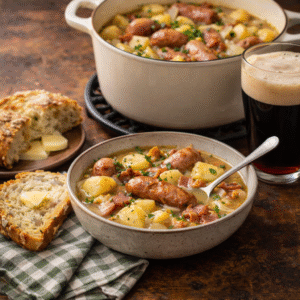 in soups and stews, stretching modest amounts of meat into satisfying meals for large families. When Irish immigrants settled in America, they continued preparing the kinds of dishes they had always known—simple pots simmering slowly on the hearth—meals that eventually became what Americans referred to as “boiled dinners.”
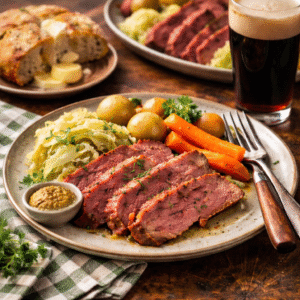
A traditional Irish boiled dinner was not the corned beef and cabbage plate that appears on so many American St. Patrick’s Day menus today. In Ireland, the more common meat would have been pork or bacon simmered with cabbage and root vegetables. Beef was typically too expensive for everyday meals.
In America, however, circumstances were a little different. Irish immigrants living in cities such as New York often found corned beef—readily available from Jewish butchers in their neighborhoods—was much more affordable than pork, making it a natural substitute for the meats they had used back home. Over time, the combination of corned beef, cabbage, potatoes, and carrots became closely associated with Irish-American cooking—and eventually with St. Patrick’s Day itself.
The result is a dish that is less traditional Irish than it is distinctly Irish-American.
Still, the spirit behind it—the idea of a hearty pot feeding family and friends—remains very much in keeping with Irish culinary traditions.
Bread tells a similar story.
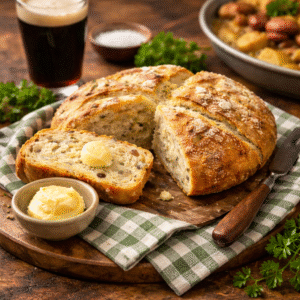 Irish soda bread, made with buttermilk and baking soda rather than yeast, reflects the practical ingenuity of rural kitchens. In places where yeast was scarce and ovens were simple, soda bread offered a reliable way to produce a sturdy loaf quickly. The chemical reaction between baking soda and acidic buttermilk created the lift needed to make bread rise.
Irish immigrants brought that technique with them, and variations of soda bread soon appeared throughout Irish communities in America.
Buttermilk itself deserves a moment of recognition.
Before refrigeration, buttermilk was a common by-product of butter churning and an important ingredient in traditional cooking. It added tang, tenderness, and moisture to breads, biscuits, and pancakes. In many ways, the buttermilk biscuits that later became synonymous with Southern cooking owe something to these earlier traditions carried by Scots-Irish settlers moving into Appalachia and the American South.
The Scots-Irish influence on American foodways.
During the eighteenth century, large numbers of Scots-Irish immigrants settled along the Appalachian frontier, stretching from Pennsylvania down through the Carolinas and into Tennessee and Kentucky. Life there demanded practical cooking—meals built from what could be grown, hunted, or preserved.
Cornmeal became a staple grain, often cooked into simple breads and porridges. Pork was cured, smoked, or salted to last through the winter months. Beans simmered slowly with bits of meat for flavor. Many of the cooking techniques that later became associated with Southern food—slow simmering, smoking, curing and frying—were part of this frontier tradition.
Distilling was another skill the Scots-Irish brought with them.
In Ireland and Scotland, distilling grains into whiskey had long been practiced. When immigrants arrived in America, they applied those same methods to locally available grains such as rye and corn. In Pennsylvania and Maryland, rye whiskey became especially popular. Farther south, corn whiskey developed into what we now recognize as bourbon and, in less formal settings, moonshine.
While whiskey might not qualify as a food in the traditional sense, it certainly played a role in both the social and culinary life of early America.
It also found its way into cooking—from sauces to desserts.
If you step back and look at the broader picture, what Irish and  Scots-Irish immigrants contributed to American cooking was not a single famous dish but rather a philosophy of cooking rooted in practicality.
Meals were hearty but straightforward. Ingredients were seasonal and often humble. Waste was avoided. And a good pot on the stove could stretch a modest pantry into something satisfying.
Those sensibilities helped shape the everyday cooking of many American households, particularly in rural communities.
Even today, you can see echoes of those traditions in dishes that feel thoroughly American: a pot of vegetable soup simmering on a cold afternoon, skillet cornbread served alongside beans, or a simple loaf of soda bread still warm from the oven.
So when St. Patrick’s Day rolls around each March, it’s worth remembering that the holiday represents more than green beer and shamrocks. It is also an opportunity to reflect on the generations of immigrants who carried their culinary traditions across the Atlantic and quietly wove them into the fabric of American cooking.
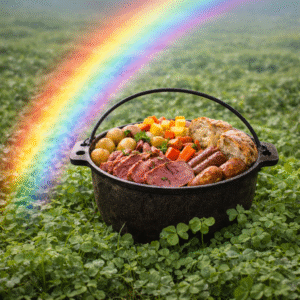 The foods may not always carry Irish names anymore, but their heritage is still there—in the root vegetables, the breads, the cured meats, and the patient simmering pots that nourish families to this day.
In that sense, the old saying about the end of the rainbow may not be far off.
Because when it comes to the American table, Irish immigrants truly did leave behind a pot of culinary gold.