The Berry That Lost to the Blueberry
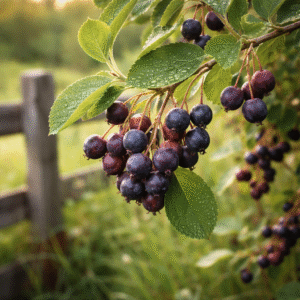
I find it a curious thing how one berry can become a national darling while another, just as sweet and just as native, slips quietly back into the hedgerow. Blueberries, plump and proud in their supermarket clamshells, have come to define the taste of American summer. We bake them into our muffins, fold them into our pancakes, and spoon them over ice cream without a second thought. But long before blueberries were cultivated, branded, and shipped coast to coast, another small purple fruit ripened faithfully along fence lines and creek beds each June. The Juneberry—known variously as shadbush, serviceberry, or Saskatoon—once fed Indigenous communities, as well as colonial and frontier families, with no thought of patents or produce marketing boards. And yet today, many Americans could walk beneath a Juneberry tree heavy with fruit and never know it.
A Native Fruit in Plain Sight
The Juneberry was not some obscure woodland experiment. Long before agricultural stations began cultivating highbush blueberries  for commercial shipment in the early twentieth century, Juneberries were ripening across the continent. Indigenous communities harvested and dried them for winter stores, often pounding them into cakes or mixing them into pemmican. Settlers followed suit, stirring them into pies and preserves, grateful for the first fresh sweetness after a lean winter. The berries required no branding, no wooden crates stamped with a grower’s logo. They grew where they pleased—along pasture edges, beside barnyards, at the edge of town. Their abundance so ordinary that no one imagined they might one day be overlooked.
So the question one must ask is: how did blueberries become a widely cultivated commercial crop in the United States while the Juneberry did not? The answer is not simple. Both fruits are native to North America. Both were important forage crops for Indigenous peoples and later for early settlers.
How the Blueberry Won the Field
In the late nineteenth century, Elizabeth White, the daughter of a New Jersey cranberry grower, developed an interest in blueberry’s potential as a cultivated crop. At the time, wild blueberries were harvested but not yet successfully domesticated. In 1911, the USDA botanist Frederick V. Coville published a groundbreaking bulletin outlining his research into the cultivation of Vaccinium species, identifying their need for acidic soil and other specific growing conditions. After reading his work, White invited Coville to conduct experiments on her family’s farm in New Jersey. Their collaboration laid the groundwork for modern commercial blueberry production. By 1916, through careful selection, crossbreeding, and propagation, they had produced the first successful cultivated crop suitable for commercial sale.
Why the Juneberry Stayed Behind
Perhaps the Juneberry’s limited commercial development in the United Sates is better explained by its disadvantages. While superior to the blueberry in several respects—greater cold hardiness, adaptability to various soil conditions, high nutritional value, excellent freezing capability, and being one of the earliest  fruits to ripen in the late spring—it presents notable challenges.
Unlike blueberries, Juneberries ripen over a rolling period rather than all at once, even within the same cluster. This makes mechanical harvesting difficult without damaging branches or collecting underripe fruit. The alternative is labor-intensive hand-picking, which increases cost.
Juneberries are also highly perishable. They can soften and discolor shortly after picking and do not store or ship as reliably as blueberries, complicating large-scale distribution.
Birds present another obstacle. They are particularly fond of Juneberries and can strip a tree before a grower has the opportunity to harvest. Protecting the crop often requires heavy netting, adding further expense.
Finally, there is the matter of familiarity. Blueberries benefited from organized promotion and marketing in the early twentieth century, while Juneberries quietly faded from memory as people moved from rural life into cities. Though similar in appearance, the Juneberry’s texture and flavor are subtly different—slightly softer, with a faint almond or cherry note from the seeds that sets it apart.
And perhaps that is how it happens. Not with scandal or failure, but with quiet practicality. The blueberry proved easier to standardize, easier to ship, easier to sell. It fit neatly into a growing nation’s appetite for uniformity. The Juneberry, by contrast, remained what it had always been—local, seasonal, a little unpredictable. It belonged more to fence rows than freight cars.
 After researching and reading about this native fruit for the purpose of writing this story, I felt it necessary to seek it out for myself. The first Juneberry I tasted did not announce itself boldly the way a supermarket blueberry does. It was smaller than I expected, its skin a dusky blue-purple with a faint bloom that rubbed away on my fingers. The flesh was tender, almost melting, and within it a softness that gave way to tiny seeds. The flavor was familiar yet not—sweet at first, then deeper, with a suggestion of almond and a whisper of cherry that lingered at the back of the tongue. It tasted less like a commodity and more like a memory, as though it had come from somewhere older than the produce aisle.
I have baked more blueberry pies than I can count, and yet I had reached this stage of life without ever tasting the berry that once preceded it. That realization gives me pause. How many other flavors have slipped from our common table simply because they resisted convenience? The Juneberry still ripens each year, just as it always has, indifferent to market share or national branding. It waits along country roads and at the edges of towns, offering sweetness to anyone curious enough to notice. And perhaps that is its quiet lesson: not every fruit was meant to conquer the country. Some were simply meant to grow where they are planted—and to be remembered by those who care to look up.